Don King, on Mike Tyson


"Why would anyone expect him to come out smarter?
He went to prison, not to Princeton."


"To me, boxing is like a ballet, except there's no music
and the dancers hit each other."

Tuesday, September 18, 2012

AHCJ | Resources - Head Injuries


From pee-wees to pros: Head injuries in sports (Margot Putukian presentation) Posted: 04/28/11

The team physician and director of athletic medicine at Princeton University offers information about concussions in young athletes.

From pee-wees to pros: Head injuries in sports (handouts) Posted: 04/28/11

These are handouts that were available at the panel "From pee-wees to pros: Head injuries in sports" at Health Journalism 2011.


AHCJ | Resources

ACRP Educational Programs

 
2011 Ringside Physicians Seminar, June 22-25 at the Olympic Training Center in Colorado Springs, CO

Each year, at the same time and place as the USA Boxing National Championships, the ACRP offers a CME program that offers 25 credits for classroom sessions and certification testing. In addtion, with attendance at ringside during the championships additional CME credits may be available.  A test on the course material is offered that can provide certification in ringside medicine from the American Board of Ringside Medicine. For information on the educational program please contact Robin Goodfellow MD at robinigoodfellow@hotmail.com.

Ringside:
The Ringside Tournament is the largest amateur boxing event in the world and is held annually in Kansas City, MO in August. This year the tournament will be held August 17-20. In 2010, more than 1500 amateur boxers registered and competed. It can provide considerable experience in ringside medicine and interaction with other experienced ringside physicians. For more information contact Robin Goodfellow MD at robinigoodfellow@hotmail.com.

Articles:

Why I Support Amateur Boxing by Ed Friedlander, MD


ACRP Educational Programs

Link: http://www.ringsidephysicians.net/ACRP_Educational_Programs.php

AMA pulls no punches, reiterates boxing ban - amednews.com

HEALTH

AMA pulls no punches, reiterates Boxing ban

Ringside physicians were denied endorsement for their efforts to make the sport safer.

By Victoria Stagg Elliott, amednews staff. July 8/15, 2002.


Is boxing just another hazardous sport like football or hang gliding that needs to be made safer? Or, is it a form of violent entertainment with no redeeming qualities?


For physicians, the debate becomes whether caring for a boxer during and after a bout is akin to standing by as a death sentence is administered to a convicted criminal or whether, instead, it is the same as caring for any patient with an injury that results from an unhealthy lifestyle choice.

These are some of the issues the American Medical Association wrestled with at its Annual Meeting in Chicago last month.

The organization considered a policy that would endorse the American Assn. of Professional Ringside Physicians, an organization of doctors working in the sport of boxing. 

The proposal ultimately failed, primarily because the AMA has a long-standing position calling for the sport to be banned. 

(Neurologists first called for boxing to be banned in 1983.)
"There is absolutely no way you can make boxing safe," said Nelson Richards, MD, a delegate from the American Academy of Neurology who proposed the original resolution to ban the sport in 1983. 

The AMA has no formal ties with the Ringside Physicians Assn., and there were many questions about how effective the organization really could be in making the sport safer.

"I don't know if we can support an organization over which we have no control," said Stephen L. Hansen, MD, an internist and California delegate from San Luis Obispo. "Also, the doctor doesn't have the control to stop the fight, and the referees may not realize when someone is in trouble."

Injury prevention, or Band-Aid?

But during the debate, two clear camps emerged. 

1.  There were those who felt that the long-standing AMA position against boxing had had little positive impact and

2.  that the presence of ringside physicians might better reduce the mortality and morbidity associated with the sport.

It was also argued that

3. the policy might even have had a negative impact by discouraging physician involvement. 

"[This new resolution] is a positive and practical step to make one of the most popular sports in the world safer," said Robert S. Rigolosi, MD, an alternate delegate from New Jersey and former college boxer.

"I encourage the AMA to accept the reality that boxing is here to stay but continue to make positive contributions on how make it a safer sport." 

But then there were those who felt that the harm-reduction model was not the way to go and there was little that the presence of a physician could do to make the sport safer.

"There is something wrong with a doc standing there watching harm being created," said Erica Frank, MD, MPH, an alternate delegate from the American College of Preventive Medicine. "It's akin to docs participating in the death penalty. By being there we endorse the activity."

Although endorsement of the ringside physicians' group was denied, the AMA has passed resolutions and reports in the past focusing on ways to make the sport safer until it can be eliminated. Delegates said they would consider such motions again. 

"I hope those physicians who are serious about safety would come back to us with resolutions suggesting increasing time between rounds for adequate medical evaluation -- no hitting above the clavicle and mandatory CT scans," said former AMA President Robert E. McAfee, MD, a long-time anti-violence activist and former college boxer. "Until then, we cannot allow our patients who happen to be boxers to sustain serious life-threatening injuries without prevention."

Meanwhile, a spokesperson from the Ringside Physicians Assn. said the ban was shortsighted and that he would be encouraging the 250 members of his organization to end their affiliation with the AMA. 

"If the AMA would like boxing to take place in bars and backrooms where there's no medical supervision, then they're going to have deaths," said Michael Schwartz, DO, an internist based in Darien, Conn., and chair and president of the organization.

"Football and auto racing are much more dangerous than boxing, but I don't hear the AMA calling for bans on those sports."


 ADDITIONAL INFORMATION: 

Weblink

American Assn. of Professional Ringside Physicians (http://www.aaprp.org/)
AMA Council on Scientific Affairs 1999 report on boxing injuries (no longer available)

Copyright 2002 American Medical Association. All rights reserved.


AMA pulls no punches, reiterates boxing ban - amednews.com

Link: http://www.ama-assn.org/amednews/2002/07/08/hlsb0708.htm


Friday, September 14, 2012

Sergio Martinez says Julio Cesar Chavez Jr. "will suffer a lot" in Saturday's fight - ESPN

 Blogger Assessment:

Saturday Night will see who is "all talk"  and my guess ia\s Martinez will prevail by KO'ing Chavez who is a tall opponent tailor made for looping punches by Martinez...But Boxing is always full of surprises.


Sergio Martinez
Marty Rosengarten for Ringsidephotos.com Sergio Martinez, coming off an all-time great knockout of Paul Williams in November 2011, was stripped of the WBC belt that is now in the possession of Saturday's opponent, Julio Cesar Chavez Jr.


Expert's View:

Trash-talking, KO-predicting lineal champ taking Saturday's fight personally

Originally Published: September 13, 2012
By Dan Rafael | ESPN.com
 
"In 2010, Martinez outpointed Kelly Pavlik to win the lineal championship and two alphabet belts. The WBO quickly stripped him, but Martinez preferred the WBC belt anyway. He defended it against Paul Williams in November 2010, scoring a spectacular second-round knockout that was the consensus KO of the Year. But then the WBC stripped Martinez when he didn't face interim titlist Sebastian Zbik -- because HBO, which was bankrolling Martinez's career, refused to approve Zbik as an opponent.

 Even after the WBC made Martinez the mandatory challenger for Chavez's belt, it took time for the fight to be made. The WBC refused to order the fight and Top Rank, Chavez's promoter, was in no hurry to make it, wanting Chavez to gain experience while Martinez grew older."


Sergio Martinez says Julio Cesar Chavez Jr. "will suffer a lot" in Saturday's fight - ESPN


 Link: http://espn.go.com/boxing/story/_/id/8373744/sergio-martinez-says-julio-cesar-chavez-jr-suffer-lot-saturday-fight


Mike Tyson: Another former great fighter in the news


Mike "I'm A Good Guy" Tyson dances to a new tune (Reuters)

Former heavyweight champion Mike Tyson gestures as he talks about the Broadway debut of his one-man show
HONG KONG (Reuters) - Former heavyweight boxing champion Mike Tyson, once notorious for his bad boy antics, has a new goal: he'd like to dance and act in musicals. "I've always been a bad guy who wanted to be a good guy," said Tyson, 46, on the sidelines of the CLSA Investor Forum in Hong Kong this week. "I didn't know how to be a good guy because I was always concentrating on being bad, so I've learned how to be a good guy now and treat people the way I want to be treated. That's why I have a passion for life now. ...


Boxing News | RingTV

Boxing great Ali honored for fights outside the ring


Boxing great Ali honored for fights outside the ring (Reuters)

Boxing great Muhammad Ali waves after being awarded the Liberty Medal, as his wife Lonnie (L) and sister-in-law Marilyn Williams (R) look on, at the National Constitution Center in Philadelphia, Pennsylvania September 13, 2012. Ali, retired world heavyweight title holder, received the $100,000 award, sponsored by the nonprofit National Constitution Center, in recognition for his humanitarian efforts and work for civil rights at an awards ceremony on Thursday. REUTERS/Tim Shaffer
PHILADELPHIA (Reuters) - Heavyweight boxing legend Muhammad Ali was honored on Thursday for his humanitarian efforts and civil rights work at an awards ceremony in Philadelphia. The $100,000 award called the Liberty Medal, sponsored by the nonprofit National Constitution Center, was presented to Ali by his daughter, Laila Ali, a former boxer herself. Ali, 70, who has been silenced by a long battle with Parkinson's disease, was honored as an icon of constitutional ideals and the American dream, the center said. ...


Boxing News | RingTV


Thursday, September 13, 2012

Head Injuries in Football - NYTimes.com


September 11, 2012
Dying to Play
By KEVIN COOK


THE beating goes on. This past Saturday a Tulane University football player, Devon Walker, collided with a teammate while making a tackle. Walker, who is 21, broke his neck. Fans gasped. Doctors performed C.P.R. He may or may not walk again.

The incident was an urgent reminder of a problem that even the National Football League seems finally ready to acknowledge: all that on-field headbanging is taking a serious toll.

Just three days earlier, the N.F.L. said that it would donate $30 million to the National Institutes of Health to support research on brain injuries and other serious medical conditions prominent in athletes — an announcement that came hours before the Giants and Cowboys kicked off the 2012-13 season in a festive, nationally televised event that drew more than 20 million viewers. (For comparison, that rivals the number of Americans who tuned in to Bill Clinton’s speech at the Democratic National Convention the same night.)

Earlier that day, the journal Neurology carried the results of a study of 3,439 retired pro football players. It reported that veterans of N.F.L. combat are more likely than the rest of us to die from brain diseases including Alzheimer’s, Parkinson’s and amyotrophic lateral sclerosis, known as Lou Gehrig’s disease. Not 50 percent more likely, or twice as likely, but three to four times more likely.

America’s ready for some football, but the human brain may never be.

More than 3,000 former players have sued the N.F.L., charging that the league failed to inform them of the dangers they faced, to protect them against concussions and to provide health care. Those men played in the years when nobody talked about getting “concussed.” You got your bell rung, your clock cleaned. You got nuked or blown up. You got your head handed to you. And unless you liked being called frilly names, you got back on the field as soon as you could locate it.

We know more about concussions today, but not how to prevent them. No helmet can offer much help, since the injury occurs when a fast-moving body suddenly stops or changes direction. The brain keeps moving until it collides with the inside of the skull, causing damage that can lead to chronic traumatic encephalopathy, or C.T.E.

Sports science’s next frontier may be discovering why some brains are so vulnerable to concussions while others seem resistant. Meanwhile, it is heartbreaking when football heroes wind up in wheelchairs or worse. John Mackey, the pioneering president of the N.F.L. Players’ Association, was found to have frontal temporal dementia in his early 60s. Former Bears safety Dave Duerson was 50 years old when he committed suicide, shooting himself in the chest so that his brain could be studied. (It showed signs of C.T.E.) Junior Seau, a 12-time Pro Bowler for the Chargers, was 43 when he shot himself in the chest last spring.

Fans may wonder whether they should support such a sport. Many parents face a more practical question: Should our kid play football? When the Raiders’ Phil Villapiano, one of the hardest hitters in N.F.L. history, watched his son Mike get his bell rung in a high school game, they had a father-son talk about it. Mike dreamed of playing college football, maybe even making the N.F.L. They both felt he wouldn’t get there by sitting on the sidelines, waiting for a doctor to send him back in. Father and son agreed: Mike kept his mouth shut and his options open. He stayed in the game and led his team to a state championship.

I’m not about to second-guess the Villapianos, whose fortitude I admire. But no family should face such a choice.

The N.F.L. now uses simple written or computerized cognitive tests to assess concussions. Before each season, players are shown a page featuring 20 words and asked to write down as many as they remember when the page is taken away. The same with 20 simple pictures: Draw as many as you can remember. Later, after an on-field hammering rings their mental bells, the pros take the same test. Match your baseline results or sit out.

Some players cheat. They purposely give wrong answers on the preseason baseline test in hopes of passing the test when they’re concussed. But no screening plan is foolproof, and this one has the virtue of simplicity. Every college and high school football program should use such a test until we find something better. Above all, though, football needs a culture change: parents, coaches and fans must never pressure an injured player to “get back in the game” before it’s clear that he’s of sound mind and body.

How should we view last week’s donation from the N.F.L. to the N.I.H.? Cynics will no doubt see the pledge as a cheap public relations move. Given that $30 million represents four and a half minutes of commercial time during the Super Bowl, the league’s donation might seem paltry.


But it’s a start.


Kevin Cook is the author of “The Last Headbangers: NFL Football in the Rowdy, Reckless ’70s — the Era That Created Modern Sports.”


Head Injuries in Football - NYTimes.com

 Link:  http://www.nytimes.com/2012/09/12/opinion/head-injuries-in-football.html?_r=1&nl=todaysheadlines&emc=edit_th_20120912


Friday, September 7, 2012

Ricky, stay retired.

INTRO: Is it a healthy decision for qa pressure fighter like Hatton to come back after some of the hard fights and terrible losses he has suffered?  How many fighters have come back because they can't stand to be out of the spotlight only to take a beating?


POW!!!


Goodnight.


Ricky Hatton is only 33 but after the way he's lived it up for most of those years they fear that his body is going on 43.


The concern, especially given a warrior instinct even harder to quench than his thirst, is that he will get himself badly hurt.


Hatton, as bright as he is brave, understands the anxiety. He's been out of the ring for three years and in that last appearance in Las Vegas he was knocked out so brutally by Manny Pacquiao that as he fell flat on his back, arms folded across his chest, for a few nasty minutes we thought he might have been killed rather than concussed.


It is hard to delete that image from any consideration of Hatton's immediate future. He does that by constantly reminding himself of how his brief fight with the PacMan was preceded by a training camp so chaotic that it left him drastically unprepared to fight one of the two greatest boxers on the planet.


Yet that in itself is not enough to convince him that he should return to battle. The most problematic question is whether that body – which he has driven through binge-boozing followed by ball-busting weight loss so often – can withstand another bout of punishment.


Working outs and  Weight Loss:


The final test will come shortly, if and when he girds himself for meaningful sparring in addition to strenuous exercise.


Meanwhile, bookings which are described as tentative, have been made for alternate dates at the MEN arena in late November and January.

Whether either is confirmed may depend as much on the television companies as Hatton's state of mind and body.


A Hitman comeback would excite all the networks and he is teasing them to come to terms with his company while not yet committing to fighting again personally.

If he does, the first fight would be against a journeyman – not a rematch with his former title victim Paulie Malignaggi - by way of preparation for a world championship campaign to follow.

His legions of fans will not care who he meets. They would pack the MEN if he fought Donald Duck, never mind a Mickey Mouse opponent.

And they would flock to Las Vegas in their tens of thousands again if he returned there to seek redemption against Pacquiao or Floyd Mayweather, the only two men to have beaten him.

Hatton is in a strong negotiating position because he does not need the money. The rich list values Hatton as worth £27 million.


Should he take the plunge it will not be for the cash but because he truly believes his body can take the strain of elite prize-fighting once again.


If so, will anyone feel bold enough to argue?


Source: Hitman Hatton fighting fit once more... but is ring return a healthy decision?

By Jeff Powell


Read more: http://www.dailymail.co.uk/sport/boxing/article-2194597/Jeff-Powell-Ricky-Hatton-fighting-fit--comeback-healthy-decision.html#ixzz25m45V3U9


Jeff Powell: Ricky Hatton fighting fit.. but is comeback a healthy decision? | Mail Online

Link:  http://www.dailymail.co.uk/sport/boxing/article-2194597/Jeff-Powell-Ricky-Hatton-fighting-fit--comeback-healthy-decision.html


Friday, August 24, 2012

Steve Gleason Is The New Face Of The NFL's Concussion Issue, And He Only Has 2-3 Years To Live - Business Insider

 Steve Gleason, NFL, Concussions, ALS
 Steve Gleason only started one game in his 7-year NFL career with the New Orleans Saints but is responsible for what some consider the most important play in that franchise's history.

Gleason blocked a punt leading to the Saints' first touchdown in the their first game back at the Superdome following Hurricane Katrina.

But three years after he last played in the NFL, Gleason was diagnosed with Amyotrophic lateral sclerosis (ALS), a disease that hits former NFL players at a higher rate and at younger ages.

HBO's "Real Sports" caught up with Gleason and talked to him about the disease and how it is affecting his life.


A large number of former NFL players have been stricken with ALS at younger ages than most people, like former Raider Steve Smith who couldn't move at the age of 45


In 2010, research revealed that repeated head trauma can cause ALS


Gleason says he was knocked out twice in the NFL, but had "his bell rung" hundreds of times

The Saints bounty-gate tapes, in which other players were targeted for injury, only came out because Gleason was visiting the team and a filmmaker documenting Gleason was in the room


Gleason is now fighting the disease, including to help build a care facility for other ALS victims in New Orleans

He even spoke at the United Nations about improved technology for people with ALS

He also works with other victims of ALS including taking them on canoe trips

He has been honored by the Saints with a statue for his famous play in 2006


HBO Sports

At home, he's preparing for a time when he will no longer be able to speak

And spending time with his young son

Sadly, the life expectancy of somebody with ALS is 3-5 years


HBO Sports

And nobody can prove the hits caused Gleason's ALS until after he dies and his brain is examined

Hopefully the NFL will continue to curb violent collisions as long as there is a chance it will mean fewer cases like Gleason

HBO Sports

Read more: http://www.businessinsider.com/steve-gleason-nfl-concussion-issue-2012-8?op=1#ixzz24RXgiURq


Steve Gleason Is The New Face Of The NFL's Concussion Issue, And He Only Has 2-3 Years To Live - Business Insider
 LINK:  http://www.businessinsider.com/steve-gleason-nfl-concussion-issue-2012-8?op=1


Sunday, July 29, 2012

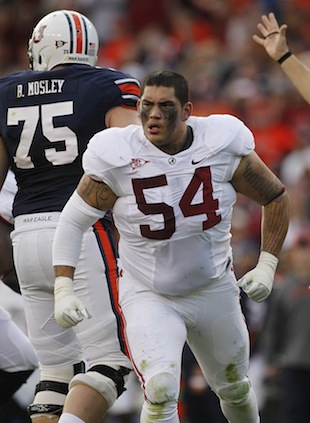
Alabama lineman bench presses 600 pounds

 This is the kind of powerful human being who is out to crush their opposition on the football field so is it little wonder that brain injuries are being sustained?


Jesse Williams, an Australia native, is a defensive lineman for Alabama, but earlier this week he proved he could easily participate in the Strongest Man competition.


(AP)According to tweets from himself and teammates, Williams benched 600 pounds Thursday. Yes, that's six plates — on either side of the bar.


"Jesse Williams dominated 600 lbs on the bench this morning... Incredible" tweeted Alabama long snapper Cade Foster, who benched a stunning 455 pounds.

To put Williams feat in perspective, former Memphis defensive tackle Dontari Poe maxed out at 500 pounds during this year's NFL scouting combine.

Williams started every game for the Crimson Tide last season. He had 24 tackles, four tackles for loss, three quarterback hurries and a pass breakup.

I'm sure the opposing offensive linemen who have seen this picture just can't wait to face Williams this fall.
- - -


Link:  http://sports.yahoo.com/blogs/ncaaf-dr-saturday/alabama-lineman-bench-presses-600-pounds-171510300--ncaaf.html;

NFL Facing Mega Lawsuit

This video is very damning talking about a cover-up of an earlier study being falsified 25 years ago that showed head injury risk was known that far back and yet the NFL continued to encourage the big hits implicated in brain injuries.

Muhammad Ali | The 20 Most Influential Americans of All Time | NewsFeed | TIME.com

 How nice to see Ali here along with other people like Albert Einstein and Martin Luther King.....


Muhammad Ali

Iconic Athlete: 1942-

By TIME Staff | July 24, 2012 | 
John Rooney / AP
John Rooney / AP
Few human beings have been so deified in their own time. Then again, few humans have spent so much of their own time deifying themselves. “I am the greatest!” Muhammad Ali often declared — and eventually, most people came around to share his view. Born Cassius Clay in Louisville, Ky., he was a prankster from childhood, and merriment always seemed to be bubbling just below his surface, sweetening his braggadocio with just the right amount of sugar. After earning fame by winning the gold medal in light-heavyweight boxing at the Rome Olympics in 1960, he rose quickly to the top of the pro ranks, prancing and dancing in the ring as no boxer ever had before, yet able to throw and take punches of terrific force.

By 1964, the “Louisville Lip” was the world champ. A modern-day P.T. Barnum, Clay had reached into boxing’s then tawdry backroom and dragged his sport back into the limelight, laughing all the way. But there was more to Clay than the amusing rhymes and the silly pranks, as Americans soon discovered: that year he declared himself a member of the Nation of Islam, a controversial movement that sought to empower African Americans, christening himself Muhammad Ali.

(PHOTOS: Happy Birthday, Muhammad Ali: 70 Iconic Images for 70 Years)

Many Americans now denounced the brash boxer as a radical, and he was even more widely vilified when he refused to join the Army as the Vietnam War escalated. “I ain’t got no quarrel with them Viet Cong” he memorably declared. He was found guilty of refusing induction into the service in 1967, and the boxing commission quickly revoked his license to fight; the U.S. Supreme Court reversed that decision in 1971.

Ali was idle for more than three years when he was at the height of his powers. Yet when he returned, he expressed no bitterness, and he still had the old magic. He won back the title in 1974 by knocking out George Foreman in their fight in Zaïre — the “Rumble in the Jungle.” Another international bout, the 1975 “Thrilla in Manila,” in which he beat Joe Frazier, helped Ali become the best-known person on the planet — and, it seemed, the most beloved. In later years, his uncomplaining battle with Parkinson’s Disease further cemented his status as a global icon of courage, grace and good will.

This entry is excerpted from the new TIME book The 100 Most Influential People of All Time, which profiles spiritual icons, leaders, explorers, visionaries and cultural titans throughout human history. Available wherever books are sold and at time.com/100peoplebook


Source:
Muhammad Ali | The 20 Most Influential Americans of All Time | NewsFeed | TIME.com

LINK: http://newsfeed.time.com/2012/07/25/the-20-most-influential-americans-of-all-time/?xid=newsletter-newsfeed#muhammad-ali