Don King, on Mike Tyson


"Why would anyone expect him to come out smarter?
He went to prison, not to Princeton."


"To me, boxing is like a ballet, except there's no music
and the dancers hit each other."

Tuesday, December 17, 2013

The Child Fighters of Thailand


The Photo Blog

Oct. 3 2013 11:04 AM

By David Rosenberg


Bank hits Tountong with his fst in the face. Both boys are 7 years old. A minimum age for the fighters does not exist.


Sandra Hoyn/laif


Photographer Sandra Hoyn was on vacation in Thailand in 2011 when she happened upon a Muay Thai competition near Bangkok. Known as “the art of eight limbs” where almost everything on the body is used including elbows, knees, and fists, Muay Thai is a full-contact sport and one that is considered extremely difficult. Professional fighters often deal with broken bones and concussions.


What shocked Hoyn the most wasn’t the sport as much as the competitors: Children as young as 6 years old were in the ring. She immediately contacted the coaches and children to photograph the fights for a series she titled “Die Kampfkinder,” or “Fighting Kids.”


Although at first Hoyn found it difficult to work on the project because of language barriers, she eventually was able to spend four weeks accompanying the children at home, during training sessions, and during competitions.


Bank has lost the boxing match against Tountong and is lying unconscious on the ground. For many poor people, Muay Thai boxing secures their livelihood. For a pittance, they reach their mental and physical limits two or three times a month with boxing matches.


Sandra Hoyn/laif


Fanta, 6 years old, after winning a boxing match.


Sandra Hoyn/laif


A boxing match between two boys.


Sandra Hoyn/laif


Hoyn studied photography at the University of Applied Sciences in Hamburg, Germany, and began developing her craft roughly 10 years ago while traveling. She said she tries to get close to the local culture and has created many series around Southeast Asia, including one about human trafficking and another about a young punk living in Burma.


“I feel the urgency to show what is happening in the world, in which circumstances people are living,” she wrote via email. “Sometimes it is difficult to keep the journalistic difference. With many protagonists of my stories, I develop a friendship, so on one side it is good for the story, while on the other hand it’s hard to stay neutral and remind myself I’m not just a friend, I’m also a photojournalist.”


A Muay Thai fighter in the boxing ring during the break.


Sandra Hoyn/laif


The coach shouts at a boy during the break of the fight.


Sandra Hoyn/laif


Although Hoyn said many people were shocked by her images of children fighting, she said in Thailand it isn’t really unusual, and it is common to see young children training, often as a way to escape poverty.


Although her photographs make it seem like a very rough sport for the children, Hoyn wrote that she didn’t see many of them seriously hurt since they aren’t as powerful as adults. “Few of these children boxers will be rewarded with fame, glory, or money,” Hoyn wrote, noting that although money bets are illegal in Thailand, they don’t seem to be enforced.


“The most shocking thing for me was to see the pressure on these children. They are the instrument for the parents to earn money, and they have to win the fight because the parents bet a lot of money on them. A lot of people lose all their money in one night,” she said.


A child fighter with money in his mouth. The victor collects money from tourists and spectators after the match. The money is divided, and the coach gets the largest share.


Sandra Hoyn/laif


A girl, 6 years old, in the boxing ring.


Sandra Hoyn/laif


Spectators at a boxing match.


Sandra Hoyn/laif


Boys wait for the upcoming boxing match.


Sandra Hoyn/laif


Left: The coach binds a boy into the boxing gloves. Right: Tountong with a trophy after he won the boxing match against Bank.


Sandra Hoyn/laif

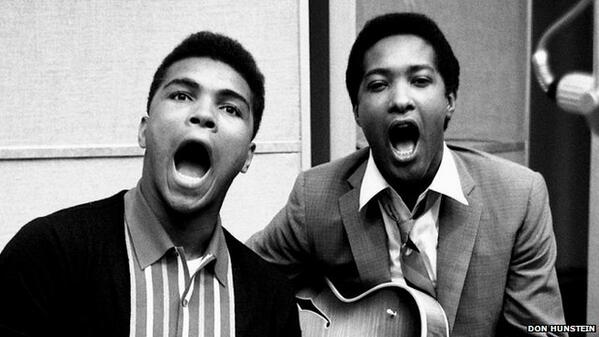
Soul stirrers Cassius Clay, left, and Sam Cooke, New York, March 1964


"Stuff you'd never see" - behind-the-scenes shots by Columbia Records' official 
photographer

 Soul man Sam Cooke, with stirrers Cassius Clay, New York City, March 1964.

Soul stirrers Cassius Clay, left, and Sam Cooke, New York, March 1964

 Boxer Cassius Clay with soul man Sam Cooke, New York City, March 1964
Don Hunstein © 2013 Sony Music Entertainment

 Print not shown here: but nice description.......

Muhammad Ali a.k.a. Cassius Clay, NYC, 1963
 
Along with the braggadocio of his boasts and rhymes, Cassius Clay brought a balletic elegance to the boxing ring. "Float like a butterfly, sting like a bee," was how he described his moves. 
 
Muhammad Ali's simultaneous defiance of gravity and convention, coupled with his invisible right and left hooks and relentless taunts gave credence to his claim, "I Am The Greatest!" On his Columbia Records album, Cassius Clay laid out, in graphic detail, a blow-by-blow description of his future bout with Sonny Liston. The album climaxed with "Round 8: The Knockout." In this photographic portrait, by Hank Parker, of Cassius Clay in formal black tails in August 1963, the future champ holds out a defiant and prescient 8 fingers, a reminder to the world that "knockout n 8" rhymes with "I Am The Greatest!"
 
Sizes: 16x20 20x24 30X40   Color: Black and White   Type: Archival Digital Print   Edition of: Limited Edition


Sports concussions and chronic traumatic encephalopathy


Sports concussions and chronic traumatic encephalopathy

Thursday 5 December 2013 
 
It's been widely reported that football and other contact sports increase the risk of a debilitating neurological condition called chronic traumatic encephalopathy (CTE).
But in the journal Neuropsychology Review, researchers are reporting only limited evidence showing a link between sports concussions and an increased risk of late-life cognitive and neuropsychiatric impairments.
Loyola University Medical Center clinical neuropsychologist Christopher Randolph, PhD, is a co-author of the paper. First author is Stella Karantzoulis, PhD, of New York University School of Medicine.
CTE is believed to be the cause of behavioral symptoms including irritability, anger, aggression, depression and suicidality; and cognitive symptoms including impaired learning, memory, language, information-processing speed and executive functioning. CTE is said to be linked to concussions and characterized by the buildup of abnormal substances in the brain called tau proteins.
But so far there is only limited evidence to support this CTE theory, Karantzoulis and Randolph write. These are among the limitations of the evidence:
  • So far CTE cases have been reported following the autopsies of athletes' brains that were donated from families concerned about the players' cognitive and behavioral symptoms before dying. But such non-random "samples of convenience" can bias findings because the samples may not be representative of the entire population of retired players.
  • The largest epidemiological study of retired NFL athletes, which included 3,439 players, found that suicide rates were actually substantially lower among these athletes than among the general population. "Given that suicidality is described as a key feature of CTE, this finding is difficult to reconcile with the high rates of CTE that have been speculated to occur in these retired athletes . . . ," Karantzoulis and Randolph write. "It is likely that there are a diverse set of risk factors for suicidality (e.g. life stress, financial difficulty, depression, chronic pain, drug abuse) in retired athletes . . ."
  • Two previous studies, including one by Randolph and colleagues, examined symptoms of retired NFL players who had mild cognitive impairment, a precursor to Alzheimer's disease. In both studies, symptoms seen in the retired players were virtually the same as those observed in non-athletes diagnosed with mild cognitive impairment. These findings cast doubt on the notion that CTE is a novel condition unique to athletes who have experienced concussions.
  • The presence of abnormal tau proteins in the brain may not be a reliable indicator of CTE. For example, various case studies have found that between 20 percent and 50 percent of subjects who had abnormal tau deposits nevertheless did not have any symptoms. "Older persons without dementia can accumulate Alzheimer's disease pathology (including tau deposition) without any associated cognitive or clinical symptoms," Karantzoulis and Randolph write. "The actual clinical significance of 'abnormal' tau deposition in the brains of retired athletes therefore remains unclear."
The authors detail how CTE originally was identified in 1928 as "punch drunk" syndrome in boxers. There is a striking parallel between the controversy over CTE today and punch drunk syndrome decades ago. In 1965, for example, a skeptic argued that punch drunk syndrome symptoms seen in boxers could have been due to alcoholism and venereal diseases, which were common in boxers at the time.
"One cannot deny that boxing and other contact sports can potentially result in some type of injury to the brain," Karantzoulis and Randolph write. "There currently are no carefully controlled data, however, to indicate a definitive association between sport-related concussion and increased risk for late-life cognitive and neuropsychiatric impairment of any form."
The authors say more rigorous and definitive studies are needed than the case reports and samples of convenience that have been done to date.


    The study is titled “Modern Chronic Traumatic Encephalopathy in Retired Athletes: What is the Evidence?"
    Randolph is a professor in the Department of Neurology of Loyola University Chicago Stritch School of Medicine.
    Loyola University Health System
    Article adapted by Medical News Today from original press release. Click 'references' tab above for source.

    Visit our Neurology / Neuroscience category page for the latest news on this subject.
    Please use one of the following formats to cite this article in your essay, paper or report:
    MLA
    Loyola University Health System. "Sports concussions and chronic traumatic encephalopathy." Medical News Today. MediLexicon, Intl., 5 Dec. 2013. Web.
    16 Dec. 2013.

    APA
    Loyola University Health System. (2013, December 5). "Sports concussions and chronic traumatic encephalopathy." Medical News Today. Retrieved from
    http://www.medicalnewstoday.com/releases/269677.

    Please note: If no author information is provided, the source is cited instead.
Rate this article (click to rate)

Sports concussions and chronic traumatic encephalopathy


Friday, December 13, 2013

Vitali Klitschko for President of the Ukraine


 http://a.espncdn.com/photo/2013/1024/box_a_klitschko01jr_400x600.jpg
AP Photo/Sergei ChuzavkovVitali Klitschko helped form the Ukrainian Democratic Alliance for Reforms in 2010 in an effort to clean up government corruption.
 
 
Heavyweight ... Boxing world champion Wladimir Klitschko, centre, stands in front of riot police during clashes between cops ...
 * Wladimir Klitschko, centre, stands in front of riot police during clashes between cops and pro-European Union activists in Kiev, Ukraine. Picture: AP
 
Vitali Klitschko
Vitali Klitschko was elected to the parliament last fall and is planning a presidential run.
AFP/Getty Images


KIEV, Ukraine (AP) -- 

 Vitali Klitschko, a heavyweight boxing champion and top Ukrainian opposition leader, says he will run for the ex-Soviet nation's presidency in 2015.

The 42-year-old was elected to parliament last fall as the head of his pro-Western party Udar ("Punch" in English).
Since then, Klitschko, the reigning WBC heavyweight champion, has campaigned against what he calls authoritarian moves by President Viktor Yanukovych.
 

Due to his reformist agenda and national celebrity status, Klitschko has become one of the country's most popular opposition leaders.


 Read More:
 
 * Wladimir is always at his side...
.............................................
 
 
Op-Ed Contributor

Ukraine's Next Great Hope? 


By GORDON MARINO


Vitali Klitschko is already the king of heavyweight boxing. But can he lead his nation out of its political turmoil?


Sunday, December 8, 2013

Why Was a Brain-Damaged Fighter Allowed to Leave Madison Square Garden on His Own?


Mike Perez punches  Magomed Abdusalamov during their Heavyweight fight at The Theater at Madison Square Garden on November 2, 2013 in New York City.  
Magomed Abdusalamov absorbs one of many heavy punches from Mike Perez.
 Photo: Al Bello/Getty Images

Why Was a Brain-Damaged Fighter NOT Attended to by Doctors at Madison Square Garden? 


The fight was one of the more brutal and exciting heavyweight fights in recent memory.   Now, the bout has taken on the full proportions of a public tragedy, with the Dagestani boxer in a coma at St. Luke’s Hospital and his family wondering why state boxing officials let the severely injured athlete walk out of the arena under his own power.

Magomed Abdusalamov was a bloody mess after ten punishing rounds against the faster, more skillful Cuban fighter.

The fighters' purses were meager: $30,000 each, perhaps just enough to cover expenses for the months of nonstop training it takes to prepare for a bout.

Abdusalamov was taken in for surgery after doctors detected swelling and a blood clot in his brain. They removed part of his skull to relieve pressure from the brain swelling and placed the fighter in an induced coma, in hopes that his condition will improve in coming days.

The mounting medical bills, which will far exceed the minimum $10,000 insurance policy that the state requires promoters to carry for fighters.....

Laz Benitez, a spokesman for the commission, which regulates all boxing matches in the state, said officials are in the process of reviewing every aspect of the fight — including the quality of the medical treatment Abdusalamov received.


Read more:

Nelson Mandela was a Boxer

Saturday, December 7, 2013

Nelson Mandela, the Boxer

View this content on Al Jazeera English's website

Mandela, the Boxer - Al Jazeera Blogs

The former South African leader was a natural, loving a sport he saw as an equaliser. 


On the Blog: Mandela, the Boxer


Tuesday, December 3, 2013

DEATH UNDER THE SPOTLIGHT :


THE MANUEL VELAZQUEZ COLLECTION , 2011


JOSEPH R. SVINTH
Copyright © EJMAS. All rights reserved.
Most recent update: October 2011 To provide additional information, to make corrections, or to request a copy of the current database, please write

jsvinth@ejmas.com

File:Joe Louis - Max Schmeling - 1936.jpg

Joe Louis looks for an opening during boxing match with Max Schmeling


Link: http://ejmas.com/jcs/velazquez/Death_Under_the_Spotlight_2011_Final.pdf


B-Hop, BERNARD HOPKINS comments on fighter in a coma

QUOTATION OF THE DAY

"I don't expect you to understand. I mean, how many people go to work and say, literally say, 'I might die tonight.' But that's boxing."
BERNARD HOPKINS, a former boxer known as the Executioner.


After the fight, Abdusalamov complained of a headache. A scan revealed he was suffering from a blood clot in his brain


 Brutal: Magomed Abdusalamov (right) lost a bloody bout with Mike Perez Saturday night in which he broke both his hand and his nose

Heavyweight boxer in a coma after losing brutal Madison Square Garden fight that broke his nose and hand

A Russian heavyweight boxer is in a medically-induced coma in critical condition after losing a brutal fight at Madison Square Garden on Saturday. Magomed Abdusalamov ...


November 20, 2013

Reconciling a Sport’s Violent Appeal as a Fighter Lies in a Coma

By GREG BISHOP


Abdusalamov fought Mike Perez at the Theater at Madison Square Garden on Nov. 2. He expected a tough bout, perhaps even a bloody one, the kind of televised fight that could propel him to greater heights.

The fight lasted 10 rounds, and Abdusalamov took the worst of the exchanges. Blood dripped from his nose and from cuts above his left eyelid. He fought most of the match with a broken hand. He kept asking his team, in Russian, how his face looked.

The consensus: great, action-packed fight.  

Magomed Abdusalamov left the arena, vomited on the curb and took a cab to the hospital.   ... members of Abdusalamov’s team said they still did not understand why Abdusalamov did not leave the Garden in an ambulance. 

A brain scan showed swelling and a blood clot. Doctors induced a coma and removed a portion of his skull. While in the coma, Abdusalamov had a stroke.

Boxing is a brutal sport, in which combatants can end up dead or impaired 
neurologically- brain damaged!


“I don’t expect you to understand,” Bernard Hopkins said. “I mean, how many people go to work and say, literally say, ‘I might die tonight.’ But that’s boxing. Whenever there’s a fight, there’s a possibility of death.”

Hopkins tells fighters to take out insurance, above what promoters are required to by commissions, which varies from state to state. He says that networks and promoters should take 3 percent of the gross revenue for televised and pay-per-view events and start a fund for boxers who incur severe injuries or worse.


“I may have an eighth-grade education, but I’m around more lawyers, more Harvard and Yale guys in boxing that never take a punch and make plenty of money,” Hopkins said. “I can’t understand that.”


Hopkins says that the culture of boxing has grown even coarser in recent years, celebrating savage blood baths over technical skill. 
He described the mind-set as, “if you don’t duck, you might get back on TV, you might get a bigger fight, and we’ll enhance your purse.”


He added, “The great Sugar Ray Robinson, the greatest fighter that ever wore gloves, would be seen as boring today in the mentality of the string pullers.”


Boxers get maimed and even killed in the Ring — not as often as they used to, thanks to more stringent safety regulations and medical supervision, and shorter careers and fewer rounds.  They die nonetheless.

More than 230 boxers died in the 1920s, and 103 died in the 2000s, according to Joseph Svinth’s 2011 study in the Journal of Combative Sport’s Manuel Velazquez Collection.       

LINK: http://ejmas.com/jcs/velazquez/Death_Under_the_Spotlight_2011_Final.pdf

Six boxers died in 2010 and three in 2011, the study said. Since the 1890s, some 1,865 boxers have died — more than half in the United States, according to the study.


Joyce Carol Oates once described boxing as a metaphor for life, with its “beauty, vulnerability, despair, incalculable and often self-destructive courage.”

Boxing is unlike any other sport in that way. It is more individualized than football: two people with nowhere to hide.

The most electrifying 30 seconds in sport are right before a big prizefight. 

Such arguments circle around an unassailable truth: 

Violence is not simply a part of boxing, it is the best part, the most visceral part, the backbone of the sport. It is what people pay to see.


Read More :

Source: http://www.nytimes.com/2013/11/21/sports/reconciling-a-sports-violent-appeal-as-a-fighter-lies-in-a-coma.html


Monday, November 25, 2013

Manny impresses with win over Rios


Pacquiao's Comeback Inspires Hopes, However Dim, for a Mayweather Bout

By GREG BISHOP

After Manny Pacquiao's victory over Brandon Rios, even the impossible - a date with Floyd Mayweather Jr. - seemed a little less so. 


Manny Pacquiao (R) of the Philippines punches Brandon Rios of the U.S. during their 'Clash in Cotai' WBO


  Link:  NYTimes.com/Sports


Saturday, November 23, 2013

How to be a Wrestler 2013 - Documentary


Published on Aug 20, 2013
 
Professional wrestling (often shortened pro wrestling, or simply wrestling) is a mode of spectacle, combining athletics and theatrical performance.[1] It takes the form of events, held by touring companies, which mimic a title match combat sport. The unique form of sport portrayed is fundamentally based on classical and "catch" wrestling, with modern additions of striking attacks, strength-based holds and throws, and acrobatic maneuvers; much of these derive from the influence of various international martial arts. An additional aspect of combat with improvised weaponry is sometimes included to varying degrees.The matches have predetermined outcomes in order to heighten entertainment value, and all combative maneuvers are executed with the full cooperation of those involved and carefully performed in specific manners intended to lessen the chance of actual injury.[2] These facts were once kept highly secretive but are now a widely accepted open secret. In the United States, this is due to the coerced public admission by Vince McMahon as the result of threatened government regulatory initiatives. By and large, the true nature of the performance is not discussed by the performing company in order to sustain and promote the willing suspension of disbelief for the audience by maintaining an aura of verisimilitude.Originating as a popular form of entertainment in 19th-century Europe[3] and later as a sideshow exhibition in North American traveling carnivals and vaudeville halls, professional wrestling grew into a standalone genre of entertainment with many diverse variations in cultures around the globe, and is now considered a multi-million dollar entertainment industry. In North America, it has experienced several different periods of prominent cultural popularity during its century and a half of existence. The advent of television gave professional wrestling a new outlet, and wrestling (along with boxing) was instrumental in making pay-per-view a viable method of content delivery.
  • Category

  • License

    Standard YouTube License


How to be a Wrestler 2013 - Documentary

Link:  http://youtu.be/w8zl_VDBVjE