Don King, on Mike Tyson


"Why would anyone expect him to come out smarter?
He went to prison, not to Princeton."


"To me, boxing is like a ballet, except there's no music
and the dancers hit each other."

Saturday, October 3, 2015

Benny Urquidez vs Onuki


Benny Urquidez vs Onuki

Benny  had good boxing skills


Benny was 49 wins no losses coming into this fight and this made it 50 to 0 which is a better winning streak than Maywether...


The Bloody Fists
Published on Oct 14, 2014


The Bloody Fists (Chinese: 荡寇滩; pinyin: Dàng Kòu Tān), aka Deadly Buddhist Raiders or Death Beach, is a 1972 Hong Kong action movie directed by See-Yuen Ng and starring Chen Siu Sing and Chen Kuan Tai. 

The memorable fight scenes were choreographed by Yuen Woo-ping, better known for choreographing Crouching Tiger, Hidden Dragon and The Matrix.

A roving band of Japanese karate fighters led by a masked, long-haired warrior (Chen Kuan Tai) enter a remote village in China hoping to get their hands on the local supply of "Dragon Herb." 

There they come into conflict with a group of Chinese kung fu fighters seeking to defend the herb. 

Tensions escalate, and the Chinese are defeated in several fights with the clearly superior Japanese force. 

Luckily, help arrives in the form of an outlaw kung fu expert (Chen Sing), who faces off against the Japanese leader in a climactic fight on the beach.

Category
Entertainment
License
Standard YouTube License


check out 6900 films


Remember?

Wheels On Meals - Benny the Jet vs Jackie Chan, Alley Encounter
https://youtu.be/KJcSvAC8cSU


Benny the Jet Urquidez tributehttps://youtu.be/cHQ21I_A094


Benny Urquidez spinning back kick and devastating ippon seoi nage
https://youtu.be/qy0-Dt9mPiI

Benny  had good boxing skills


Learn to be skilled by training in the Martial Arts


Thursday, October 1, 2015

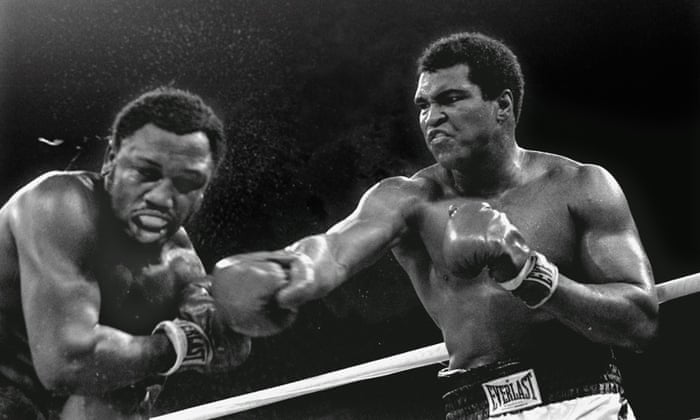
Muhammad to stay on his mountain - Ali v Frazier: archive, 2 October 1975 | Sport | The Guardian

After one of the most incredible matches in boxing history, Ali will find it hard to step away from the ring.


Even those with a passion for, and an understanding of, the artistry and skills of boxing flinched at a fight that went through to the ceiling of sporting entertainment; where the will of two men was so unyielding that their disciplined sport was at a level of animalism. On the vast cinema screen which closed circuit television provides that was how it seemed in the early hours of Wednesday morning.
 
Men have administered punishment and other men have suffered it to a similar degree, but rarely have two fighters, at this level, fought to the point where there was nothing left to give.

In the end it was neither of the fighters who conceded but those in Frazier’s corner, who feared for his health. With one eye closed, Frazier’s face puffed and bruised, men hardened by a working life in the fighter’s corner – of towels and sponges of adrenalin for cuts – they were the ones who shuddered and said: “Enough.” Frazier, long beyond the normal realms of response, so utterly committed was he to his campaign of getting to Ali at fiercesome physical cost, had no word of argument.


Read more:

Muhammad to stay on his mountain - Ali v Frazier: archive, 2 October 1975 | Sport | The Guardian:

http://www.theguardian.com/sport/2015/oct/02/muhammad-ali-joe-frazier-manila-1975#img-1

'via Blog this'


Michael Moorer


Wednesday, September 30, 2015

Motivating Yourself with Earl Nigh0tingale


 This is a transcript...

The Strangest Secret


Transcribed from The Strangest Secret audio program by Earl Nightingale


Some years ago, the late Nobel prize-winning Dr. Albert Schweitzer was asked by a reporter, “Doctor, what’s wrong with men today?” The great doctor was silent a moment, and then he said, “Men simply don’t think!”

It’s about this that I want to talk with you. We live today in a golden age. This is an era that humanity has looked forward to, dreamed of, and worked toward for thousands of years. We live in the richest era that ever existed on the face of the earth … a land of abundant opportunity for everyone.

However, if you take 100 individuals who start even at the age of 25, do you have any idea what will happen to those men and women by the time they’re 65? These 100 people believe they’re going to be successful. They are eager toward life, there is a certain sparkle in their eye, an erectness to their carriage, and life seems like a pretty interesting adventure to them.

But by the time they’re 65, only one will be rich, four will be financially independent, five will still be working, and 54 will be broke and depending on others for life’s necessities.

Only five out of 100 make the grade! Why do so many fail? What has happened to the sparkle that was there when they were 25? What has become of the dreams, the hopes, the plans … and why is there such a large disparity between what these people intended to do and what they actually accomplished?

THE DEFINITION OF SUCCESS

First, we have to define success and here is the best definition I’ve ever been able to find:

“Success is the progressive realization of a worthy ideal.”

A success is the school teacher who is teaching because that’s what he or she wants to do. A success is the entrepreneur who start his own company because that was his dream and that’s what he wanted to do. A success is the salesperson who wants to become the best salesperson in his or her company and sets forth on the pursuit of that goal.

A success is anyone who is realizing a worthy predetermined ideal, because that’s what he or she decided to do … deliberately. But only one out of 20 does that! The rest are “failures.”

Rollo May, the distinguished psychiatrist, wrote a wonderful book called Man’s Search for Himself, and in this book he says: “The opposite of courage in our society is not cowardice … it is conformity.” And there you have the reason for so many failures. Conformity and people acting like everyone else, without knowing why or where they are going.

We learn to read by the time we’re seven. We learn to make a living by the time we’re 30. Often by that time we’re not only making a living, we’re supporting a family. And yet by the time we’re 65, we haven’t learned how to become financially independent in the richest land that has ever been known. Why? We conform! Most of us are acting like the wrong percentage group and the 95 who don’t succeed.

GOALS

Have you ever wondered why so many people work so hard and honestly without ever achieving anything in particular, and why others don’t seem to work hard, yet seem to get everything? They seem to have the “magic touch.” You’ve heard people say, “Everything he touches turns to gold.” Have you ever noticed that a person who becomes successful tends to continue to become more successful? And, on the other hand, have you noticed how someone who’s a failure tends to continue to fail?

The difference is goals. 

People with goals succeed because they know where they’re going. It’s that simple. 

Failures, on the other hand, believe that their lives are shaped by circumstances … by things that happen to them … by exterior forces.
Think of a ship with the complete voyage mapped out and planned. The captain and crew know exactly where the ship is going and how long it will take and it has a definite goal. And 9,999 times out of 10,000, it will get there.

Now let’s take another ship and just like the first and only let’s not put a crew on it, or a captain at the helm. Let’s give it no aiming point, no goal, and no destination. We just start the engines and let it go. I think you’ll agree that if it gets out of the harbor at all, it will either sink or wind up on some deserted beach and a derelict. It can’t go anyplace because it has no destination and no guidance.

It’s the same with a human being. However, the human race is fixed, not to prevent the strong from winning, but to prevent the weak from losing. Society today can be likened to a convoy in time of war. The entire society is slowed down to protect its weakest link, just as the naval convoy has to go at the speed that will permit its slowest vessel to remain in formation.

That’s why it’s so easy to make a living today. It takes no particular brains or talent to make a living and support a family today. We have a plateau of so-called “security.” So, to succeed, all we must do is decide how high above this plateau we want to aim.

Throughout history, the great wise men and teachers, philosophers, and prophets have disagreed with one another on many different things. It is only on this one point that they are in complete and unanimous agreement and the key to success and the key to failure is this:

WE BECOME WHAT WE THINK ABOUT

This is The Strangest Secret! Now, why do I say it’s strange, and why do I call it a secret? Actually, it isn’t a secret at all. It was first promulgated by some of the earliest wise men, and it appears again and again throughout the Bible. But very few people have learned it or understand it. That’s why it’s strange, and why for some equally strange reason it virtually remains a secret.

Marcus Aurelius, the great Roman Emperor, said: “A man’s life is what his thoughts make of it.”

Disraeli said this: “Everything comes if a man will only wait … a human being with a settled purpose must accomplish it, and nothing can resist a will that will stake even existence for its fulfillment.”

William James said: “We need only in cold blood act as if the thing in question were real, and it will become infallibly real by growing into such a connection with our life that it will become real. It will become so knit with habit and emotion that our interests in it will be those which characterize belief.” 

He continues, ” … only you must, then, really wish these things, and wish them exclusively, and not wish at the same time a hundred other incompatible things just as strongly.”

My old friend Dr. Norman Vincent Peale put it this way: “If you think in negative terms, you will get negative results. If you think in positive terms, you will achieve positive results.” 

George Bernard Shaw said: “People are always blaming their circumstances for what they are. I don’t believe in circumstances. The people who get on in this world are the people who get up and look for the circumstances they want, and if they can’t find them, make them.”

Well, it’s pretty apparent, isn’t it?   We become what we think about. 

A person who is thinking about a concrete and worthwhile goal is going to reach it, because that’s what he’s thinking about. 

Conversely, the person who has no goal, who doesn’t know where he’s going, and whose thoughts must therefore be thoughts of confusion, anxiety, fear, and worry will thereby create a life of frustration, fear, anxiety and worry. And if he thinks about nothing … he becomes nothing.


AS YE SOW, SO SHALL YE REAP

The human mind is much like a farmer’s land. The land gives the farmer a choice. He may plant in that land whatever he chooses. The land doesn’t care what is planted. It’s up to the farmer to make the decision. 

The mind, like the land, will return what you plant, but it doesn’t care what you plant. If the farmer plants too seeds and one a seed of corn, the other nightshade, a deadly poison, waters and takes care of the land, what will happen?

Remember, the land doesn’t care. It will return poison in just as wonderful abundance as it will corn. So up come the two plants and one corn, one poison as it’s written in the Bible, “As ye sow, so shall ye reap.”

The human mind is far more fertile, far more incredible and mysterious than the land, but it works the same way. It doesn’t care what we plant … success … or failure. A concrete, worthwhile goal … or confusion, misunderstanding, fear, anxiety, and so on. But what we plant it must return to us.


The problem is that our mind comes as standard equipment at birth. It’s free. And things that are given to us for nothing, we place little value on. Things that we pay money for, we value.

The paradox is that exactly the reverse is true. 

Everything that’s really worthwhile in life came to us free and our minds, our souls, our bodies, our hopes, our dreams, our ambitions, our intelligence, our love of family and children and friends and country. All these priceless possessions are free.

But the things that cost us money are actually very cheap and can be replaced at any time. A good man can be completely wiped out and make another fortune. He can do that several times. Even if our home burns down, we can rebuild it. But the things we got for nothing, we can never replace.

Our mind can do any kind of job we assign to it, but generally speaking, we use it for little jobs instead of big ones. 


So decide now. What is it you want? Plant your goal in your mind. It’s the most important decision you’ll ever make in your entire life.

Do you want to excel at your particular job? Do you want to go places in your company … in your community? Do you want to get rich?

All you have got to do is plant that seed in your mind, care for it, work steadily toward your goal, and it will become a reality.

It not only will, there’s no way that it cannot. You see, that’s a law and like the laws of Sir Isaac Newton, the laws of gravity. If you get on top of a building and jump off, you’ll always go down and you’ll never go up.

And it’s the same with all the other laws of nature. They always work. They’re inflexible. 

Think about your goal in a relaxed, positive way. 

Picture yourself in your mind’s eye as having already achieved this goal. 

See yourself doing the things you will be doing when you have reached your goal.

Every one of us is the sum total of our own thoughts. 

We are where we are because that’s exactly where we really want or feel we deserve to be and whether we’ll admit that or not. 

Each of us must live off the fruit of our thoughts in the future, because what you think today and tomorrow and next month and next year and will mold your life and determine your future. You’re guided by your mind.

I remember one time I was driving through e a s t e r n Arizona and I saw one of those giant earth-moving machines roaring along the road with what looked like 30 tons of dirt in it and a tremendous, incredible machine and and there was a little man perched way up on top with the wheel in his hands, guiding it.

As I drove along I was struck by the similarity of that machine to the human mind. 

Just suppose you’re sitting at the controls of such a vast source of energy. 

Are you going to sit back and fold your arms and let it run itself into a ditch?

Or are you going to keep both hands firmly on the wheel and control and direct this power to a specific, worthwhile purpose? 

It’s up to you. You’re in the driver’s seat. 

You see, the very law that gives us success is a double-edged sword. 

We must control our thinking. 

The same rule that can lead people to lives of success, wealth, happiness, and all the things they ever dreamed of and that very same law can lead them into the gutter. 

It’s all in how they use it … for good or for bad. 

That is The Strangest Secret!

Do what the experts since the dawn of recorded history have told us to do:

pay the price, by becoming the person you want to become. 

It’s not nearly as difficult as living unsuccessfully.

The moment you decide on a goal to work toward, you’re immediately a successful person 
and you are then in that rare group of people who know where they’re going. 

Out of every hundred people, you belong to the top five. 

Don’t concern yourself too much with how you are going to achieve your goal.

 Leave that completely to a power greater than yourself. 

All you have to do is know where you’re going. The answers will come to you of their own accord, and at the right time.

Start today. You have nothing to lose and but you have your whole life to win.


30-DAY ACTION IDEAS FOR PUTTING THE STRANGEST SECRET TO WORK FOR YOU:

For the next 30-days follow each of these steps every day until you have achieved your goal.

1. Write on a card what it is you want more that anything else
. It may be more money. Perhaps you’d like to double your income or make a specific amount of money. It may be a beautiful home. It may be success at your job. It may be a particular position in life. It could be a more harmonious family.

Write down on your card specifically what it is you want. Make sure it’s a single goal and clearly defined. 
You needn’t show it to anyone, but carry it with you so that you can look at it several times a day. 

Think about it in a cheerful, relaxed, positive way each morning when you get up, and immediately you have something to work for and something to get out of bed for, something to live for.

Look at it every chance you get during the day and just before going to bed at night. 


As you look at it, remember that you must become what you think about, and since you’re thinking about your goal, you realize that soon it will be yours. In fact, it’s really yours the moment you write it down and begin to think about it.

2. Stop thinking about what it is you fear. 

Each time a fearful or negative thought comes into your mind, replace it with a mental picture of your positive and worthwhile goal. 

And there will come a time when you’ll feel like giving up. It’s easier for a human being to think negatively than positively. That’s why only five percent are successful! You must begin now to place yourself in that group.

“Act as though it were impossible to fail,” as Dorothea Brande said. No matter what your goal, if you’ve kept your goal before you every day, you’ll wonder and marvel at this new life you’ve found.


3. Your success will always be measured by the quality and quantity of service you render. 

Most people will tell you that they want to make money, without understanding this law. The only people who make money work in a mint. The rest of us must earn money. This is what causes those who keep looking for something for nothing, or a free ride, to fail in life. 

Success is not the result of making money; earning money is the result of success and and success is in direct proportion to our service.

Most people have this law backwards. It’s like the man who stands in front of the stove and says to it: “Give me heat and then I’ll add the wood.” 

How many men and women do you know, or do you suppose there are today, who take the same attitude toward life? There are millions.

We’ve got to put the fuel in before we can expect heat. 


Likewise, we’ve got to be of service first before we can expect money. 

Don’t concern yourself with the money. Be of service … build … work … dream … create! Do this and you’ll find there is no limit to the prosperity and abundance that will come to you.

Don’t start your test until you’ve made up your mind to stick with it. If you should fail during your first 30 days and by that I mean suddenly find yourself overwhelmed by negative thoughts and simply start over again from that point and go 30 more days.

Gradually, your new habit will form, until you find yourself one of that wonderful minority to whom virtually nothing is impossible.

Above all … don’t worry! Worry brings fear, and fear is crippling. 


The only thing that can cause you to worry during your test is trying to do it all yourself. 

Know that all you have to do is hold your goal before you; everything else will take care of itself.

Take this 30-day test, then repeat it … then repeat it again. Each time it will become more a part of you until you’ll wonder how you could have ever have lived any other way.

Live this new way and the floodgates of abundance will open and pour over you more riches than you may have dreamed existed. Money? Yes, lots of it. 

But what’s more important, you’ll have peace … you’ll be in that wonderful minority who lead calm, cheerful, successful lives.


Learn more about Earl Nightingale and his many timeless books and audio programs.
The Strangest Secret
The Strangest Secret Article by: Earl Nightingale


See more at: 


Learn more about Earl Nightingale and his many timeless books and audio programs.

The Strangest Secret - Advantedge Article By Earl Nightingale

LINK:  http://www.nightingale.com/ae_article~i~22~article~strangestsecret.aspx


The Strangest Secret Earl Nightingale Conant 1950's Origional FULL 31:35 Min.
31:35 - 4 years ago
Earl Nightingale Conant The Strangest Secret 1956 1950's

Tuesday, September 29, 2015

Ex-NFL quarterback Erik Kramer shoots himself in suicide 'over injury' | Daily Mail Online


"'He is not the same man I married': Former NFL quarterback shoots himself as ex-wife blames failed 'suicide bid' on football head injury
Ex-quarterback Erik Kramer 'shot himself in a suicide attempt but survived'

His former wife said he 'suffered depression since he was with the Bears'
She blames his football injury for both their divorce and his 'suicide bid' 

2014 report revealed alarmingly high risk of mental health issues to players


Former NFL quarterback Erik Kramer shot himself on Wednesday night in what police believe was a suicide attempt.
The 50-year-old, who survived the shooting, had suffered from depression for years, according to his ex-wife.
Law enforcement officials, called to a motel in the Los Angeles area around 8pm on Tuesday, reported that Kramer ‘shot himself in a suicide attempt, but survived’.

The player’s former wife, Marshawn Kramer, also confirmed that it had been a suicide attempt.
‘He is a very amazing man, a beautiful soul, but he has suffered depression since he was with the Bears,’ she told NBC News.

‘I can promise you he is not the same man I married.’

Ms Kramer believes that Kramer’s depression is a direct result of his time in the NFL.

The quarterback is most well known for his time as the Chicago Bears starting quarterback in from 1995 until 1997. 

He suffered two serious neck injuries during his career, one of which meant he missed much of the 1996 season and the other which forced him to retire in 1999. 

Ms Kramer added: ‘I know Erik and I would still be together if not for his football injury.’

The couple, who divorced in 2010, lost their 18-year-old son Griffen, then a high-school quarterback, after he died from a drug overdose in 2011.They have another 17-year-old son Dillon.

Kramer’s alleged suicide attempt comes amid fierce debate about the risks of mental health issues that former NFL players face.


Read more: http://www.dailymail.co.uk/news/article-3204705/Former-NFL-quarterback-shoots-ex-wife-blames-suicide-bid-football-head-injury.html#ixzz3n72x1okM


By IMOGEN CALDERWOOD FOR MAILONLINE

PUBLISHED: 12:01 GMT, 20 August 2015 | UPDATED: 19:14 GMT, 20 August 2015"

Ex-NFL quarterback Erik Kramer shoots himself in suicide 'over injury' | Daily Mail Online:

'via Blog this'


Study: Ex-soldiers have same brain damage as NFL players who committed suicide | FOX31 Denver


Scans of living brains show patterns of chronic traumatic encephalopathy, or CTE. (Credit: PNAS/UCLA)


Study: Ex-soldiers have same brain damage as NFL players who committed suicide


POSTED 3:20 PM, APRIL 6, 2015, BY CNN WIRE


WASHINGTON — After his last tour in Iraq, it took master gunner Shane Garcie about six weeks to notice he’d changed.


“Your brain is throwing parties because you’re home, you’re alive,” says Garcie. “So, it doesn’t settle in right away.”


Now he’s not sure what bothers him most: the fogginess of his brain, the anger that can erupt from nowhere or the deep, dark depressions he can’t shake off.


“One minute I’m in a good happy mood, everything is cool; the next minute I’m depressed,” Garcie said. “I don’t want to be around anybody, I want to isolate. Some days, I don’t want to get out of bed.”


“We could walk around this town and everybody, 90% of these people, would say, ‘Hey, Shane, hey,’ ” Garcie says about his hometown of Natchitoches, Louisiana. “But it’s not Shane. It looks like me, it walks like me, it talks like me, but it’s not me because of the damage.”


Since 1984, Green Beret Tommy Shoemaker has served in many war theaters — Kuwait, Iraq, Afghanistan, Somalia, Bosnia — and is still an Army reservist. He came home from Iraq to Monroe, Louisiana, in late 2006 with a bum leg and a disabled brain.


“I carry note cards and a pen with me everywhere I go, and when I’m talking to somebody, I write it down,” Shoemaker told Gupta. “Because if I don’t, I won’t remember. I mean memory was not a problem for me, I could remember anything. And now I have to write everything down.”


But it’s the mood swings he can’t control that do the most harm.


“I’ve always been really easygoing. Everything rolled off my back, no problems,” says Shoemaker in his Southern drawl.


“But now that’s not so. I mean, I’ll get mad over something as simple as a banana peel in the front yard or my wife saying the wrong thing to me, and is it really anything? No, but at that moment, it hits me and I just do things that I would’ve never done before. I yell, I scream, I holler, and that’s just never been my manner. I’m sad for my kids and my wife to have to live with that.”


“It’s tough, really tough,” agrees Pam Shoemaker, Tommy’s wife. “I do remember him telling me that ‘I’m different,’ ‘I’m not the same'” when he first came home. “I didn’t understand. But I do now.”

Brain studies


Dr. Julian Bailes, co-director of the NorthShore Neurological Institute in Evanston, Illinois, is pointing at the angry red and vivid yellow blooms on the PET scan of a living brain.


“Compared to normal controls, you see abnormal binding in the areas under the surface of the brain and deeper in the brain, showing abnormal accumulations of tau protein,” he explains.


All are signs of CTE, or chronic traumatic encephalopathy, a crippling neurological disorder caused by repeated blows to the head.


Characterized by deep depression, failing memory and anger that lurks just under the surface, CTE is a form of dementia that first came to light in the boxing world. “Punch drunk” was the term most often used for former pugilists, such as Muhammad Ali, who developed brain damage after a lifetime of hard knocks. Today it’s called dementia pugilistica and is considered a variant of CTE.


CTE is the disease many believe played a role in the deaths of former NFL players like Ray Easterling, Junior Seau, Shane Dronett and Dave Duerson. They all shot themselves. Duerson left a note asking that his brain be studied.


RELATED: Chris Borland, 24, retires from NFL over concussion fears


Images like these are traditionally gathered post-mortem, from brain samples taken at autopsy. That’s been the only way CTE could be diagnosed. Only a handful of studies have looked at living brains, with the hope a diagnosis could be made before death.


“Looking at living brains is a remarkable contribution to the science right now, a really remarkable contribution,” Dr. Geoffrey Ling said. Ling is director of the Biological Technologies office at DARPA, the Defense Advanced Research Projects Agency. “It is very exciting and the potential is dramatic.”


In one of the largest studies of its kind to date, Bailes and his co-authors at UCLA compared the living brains of 14 former athletes thought to have CTE, 24 patients diagnosed with Alzheimer’s disease and two ex-soldiers, Tommy Shoemaker and Shane Garcie, to a control group of 28 cognitively normal people.


The researchers injected the participants with a radioactive “tracer” called [f-18]FDDNP before their PET scans. The tracer latches on to a brain protein called tau, which is thought to be responsible for much of the damage in Alzheimer’s and other degenerative brain disorders, and lights up areas of the brain that are affected.


“For us to be able to make the diagnosis of the injury or the disease in living people is paramount to being able to help them, treat them and to find some way to keep them out of progressing into a terminal problem,” says Bailes.


The scans of the ex-soldiers was a plus: a tiny sample designed to give a glimpse into what might be causing their debilitating symptoms.


And they offer a chance to explore what many experts are beginning to suspect: The blasts and energy jolts common in warfare might be creating a new form of CTE, a “blast-variant” version.


“In the military, it seems it would be vitally important to know who has been exposed to this, and then be able to identify, mark, follow the progression of brain degeneration from blast injury,” says Bailes. “And to know who’s at risk and maybe who needs to be pulled out of harm’s way permanently.”


Sure enough, the specific pattern of the tau the researchers found in Garcie and Shoemaker’s brains didn’t look at all like Alzheimer’s. Instead, it looked similar to the tau display found in the 14 players suspected of having CTE and the results taken from brain autopsies of people diagnosed with CTE.


And it looked similar to what had been found in a previous study by Bailes and his UCLA colleagues of the living brains of five NFL football players who were suspected of having CTE.

‘So many’ concussions


According to the Brain Trauma Foundation, 10% to 20% of Iraqi veterans are suffering from some level of traumatic brain disorder. The foundation even calls it the “signature injury” of the wars in Iraq and Afghanistan.


“One was a suicide bomber,” says Shoemaker. He’s recalling the last — and worst — of some 35 concussions he’s had over his military career. While about half of those rendered him unconscious, he says his training often took over.


“I was in an open vehicle with no top between me and the explosion. So I had some shrapnel and suffered a concussion, but I was able to stay focused enough with muscle memory to just keep driving, ’til my head kind of cleared, and I kept going.”


“And the other one was a roadside bomb. I was knocked unconscious but again was able to just out of memory continue driving, not even realizing what had happened.”


Shane Garcie can’t recall how many concussions he’s had.


“No, because there’s so many. There’s so many,” says Garcie. “There are so many reasons for the jarrings, for the beatings. Not just IEDs, not just car bombs, not just in a firefight or grenades going off.”


“Think about it, you know. Iraq doesn’t have the best roads,” Garcie continues. “And you hit that bump and your head — it smacks the turret. Rollovers are severe because of the canals. I mean, you’re driving in blackout mode on dark nights, with nods on and no lights — you can barely see 10 feet in front of you. There are so many ways it can happen.”

New form of dementia?


The science of CTE is in its infancy. A band of researchers around the country has been racing to catalog as much information as possible, to answer the questions: Is CTE distinct enough to be diagnosed? Is it a “new” neurodegenerative disease?


“Before people run out and say, ‘Oh, this person has CTE, or that person has CTE,’ I think that’d be way premature to do that,” says Ling. “Chronic traumatic encephalopathy, that’s a condition that still needs further study.”


Researchers struggle with how to tease out the differences between post-concussion syndrome, a chronic but stable disease, and CTE, which early research shows spreads from the initial site of impact throughout the brain and worsens with age.


“There’s so many things about CTE we don’t understand,” says Bailes. “There never has been long-term longitudinal studies that analyze who gets it and exactly why, what the prevalence of it is, and then who progresses. There may be a group that doesn’t progress.”


The type of radioactive marker to use, and how accurate it is in binding to tau protein, is also under scrutiny. A number of tau trackers are in the works, and each seem to have unique characteristics. The UCLA study’s [f-18]FDDNP is an older marker that critics say isn’t specific enough because it can also bind to amyloids, which are misfolded proteins commonly seen in Alzheimer’s brains.


Bailes and several of his UCLA co-authors have launched a company to develop [f-18]FDDNP, and they defend their tracer this way: “Most CTE sufferers have been found at autopsy to have tau, but also about 40% have had amyloid as well. So they are showing both degeneration markers in the brain,” says Bailes.


“Most importantly, it’s a distinct pattern that we haven’t seen in any other condition — not in Alzheimer’s, not in other forms of dementia, and certainly not in normal controls. So it’s not just what we’re binding to, it’s that this pattern appears to be distinct and it appears to be the areas that have been damaged in autopsy studies of sufferers with CTE.”


Ling has a more global view. “In the end, these scans are just scans. That’s all that they are. It really has to do with the context of the patient. We have to understand the patient: What is their history? Do they have multiple head injuries? Do they have anything else that could compound this?”

Right now, prevention is the only treatment


At this time, there is no cure for CTE. There are no real treatments, either. All that can be done is to treat the symptoms. Psychotherapy and antidepressants are often prescribed for anxiety and anger, while memory issues are tackled with lifestyle and diet changes that may or may not help.


“There really is no concussion pill, there’s no specific medication we have to treat these,” says Bailes. “It’s recognition, it’s taking that individual out of harm’s way for future impacts or blast injury, and it’s allowing the brain to heal.”


Experts agree that accurately identifying brain injury on the spot is critical. That’s because the risk increases each time you have one. “Every concussion predisposes you to be a little more sensitive to have another one, especially if they are in close proximity time wise,” says Bailes.


The hope is that science will develop a test that can diagnose brain trauma in war zones or on the sidelines of a football game at the time of injury. Several are in development, but only a pencil-and-paper test is in use right now.


For Shane Garcie, all that matters is what can be done to keep other soldiers from ending up like him.


“I’ve talked to other doctors and a couple of neurologists and neurosurgeons, and they’re like, ‘Man, really, I don’t know how you’re functioning like you are,’ he says. “I could’ve been a comedian. I was very quick-witted, very smart. Now I stutter. I sputter. I lose words. I can be having a conversation and forget everything we’re talking about.”


“But it’s not just Shane that’s having all these brain issues. There were thousands of troops who were getting blasted by IEDs, car bombs, RPGs, grenades. I want them to know that they’re not alone.”


For Tommy Shoemaker, it’s important that soldiers with CTE receive a physical diagnosis, rather than just being lumped under the umbrella of post-traumatic stress disorder. To him, it matters a great deal that his symptoms are the result of a brain injury, instead of the inability to cope with the emotional fallout of trauma.


“People are more apt to accept a physical disorder than they are mental disorders,” he says. “So if you can do that for soldiers, I think that’s a big plus.”


“I think it’s a plus when they go to get a job, you know, and they ask ’em: ‘Do you have a mental disorder?’ Well no, I don’t. I have a brain injury. Nobody wants to be diagnosed as having a mental disorder.”


TRADEMARK AND COPYRIGHT 2015 CABLE NEWS NETWORK, INC., A TIME WARNER COMPANY. ALL RIGHTS RESERVED.


FILED IN: NATIONAL/WORLD NEWS


Study: Ex-soldiers have same brain damage as NFL players who committed suicide | FOX31 Denver:


http://kdvr.com/2015/04/06/study-ex-soldiers-have-same-brain-damage-as-nfl-players-who-committed-suicide/


'via Blog this'


Study: Ex-soldiers have same brain damage as NFL players who committed suicide | FOX31 Denver


Scans of living brains show patterns of chronic traumatic encephalopathy, or CTE. (Credit: PNAS/UCLA)


Study: Ex-soldiers have same brain damage as NFL players who committed suicide


POSTED 3:20 PM, APRIL 6, 2015, BY CNN WIRE


WASHINGTON — After his last tour in Iraq, it took master gunner Shane Garcie about six weeks to notice he’d changed.


“Your brain is throwing parties because you’re home, you’re alive,” says Garcie. “So, it doesn’t settle in right away.”


Now he’s not sure what bothers him most: the fogginess of his brain, the anger that can erupt from nowhere or the deep, dark depressions he can’t shake off.


“One minute I’m in a good happy mood, everything is cool; the next minute I’m depressed,” Garcie said. “I don’t want to be around anybody, I want to isolate. Some days, I don’t want to get out of bed.”


“We could walk around this town and everybody, 90% of these people, would say, ‘Hey, Shane, hey,’ ” Garcie says about his hometown of Natchitoches, Louisiana. “But it’s not Shane. It looks like me, it walks like me, it talks like me, but it’s not me because of the damage.”


Since 1984, Green Beret Tommy Shoemaker has served in many war theaters — Kuwait, Iraq, Afghanistan, Somalia, Bosnia — and is still an Army reservist. He came home from Iraq to Monroe, Louisiana, in late 2006 with a bum leg and a disabled brain.


“I carry note cards and a pen with me everywhere I go, and when I’m talking to somebody, I write it down,” Shoemaker told Gupta. “Because if I don’t, I won’t remember. I mean memory was not a problem for me, I could remember anything. And now I have to write everything down.”


But it’s the mood swings he can’t control that do the most harm.


“I’ve always been really easygoing. Everything rolled off my back, no problems,” says Shoemaker in his Southern drawl.


“But now that’s not so. I mean, I’ll get mad over something as simple as a banana peel in the front yard or my wife saying the wrong thing to me, and is it really anything? No, but at that moment, it hits me and I just do things that I would’ve never done before. I yell, I scream, I holler, and that’s just never been my manner. I’m sad for my kids and my wife to have to live with that.”


“It’s tough, really tough,” agrees Pam Shoemaker, Tommy’s wife. “I do remember him telling me that ‘I’m different,’ ‘I’m not the same'” when he first came home. “I didn’t understand. But I do now.”

Brain studies


Dr. Julian Bailes, co-director of the NorthShore Neurological Institute in Evanston, Illinois, is pointing at the angry red and vivid yellow blooms on the PET scan of a living brain.


“Compared to normal controls, you see abnormal binding in the areas under the surface of the brain and deeper in the brain, showing abnormal accumulations of tau protein,” he explains.


All are signs of CTE, or chronic traumatic encephalopathy, a crippling neurological disorder caused by repeated blows to the head.


Characterized by deep depression, failing memory and anger that lurks just under the surface, CTE is a form of dementia that first came to light in the boxing world. “Punch drunk” was the term most often used for former pugilists, such as Muhammad Ali, who developed brain damage after a lifetime of hard knocks. Today it’s called dementia pugilistica and is considered a variant of CTE.


CTE is the disease many believe played a role in the deaths of former NFL players like Ray Easterling, Junior Seau, Shane Dronett and Dave Duerson. They all shot themselves. Duerson left a note asking that his brain be studied.


RELATED: Chris Borland, 24, retires from NFL over concussion fears


Images like these are traditionally gathered post-mortem, from brain samples taken at autopsy. That’s been the only way CTE could be diagnosed. Only a handful of studies have looked at living brains, with the hope a diagnosis could be made before death.


“Looking at living brains is a remarkable contribution to the science right now, a really remarkable contribution,” Dr. Geoffrey Ling said. Ling is director of the Biological Technologies office at DARPA, the Defense Advanced Research Projects Agency. “It is very exciting and the potential is dramatic.”


In one of the largest studies of its kind to date, Bailes and his co-authors at UCLA compared the living brains of 14 former athletes thought to have CTE, 24 patients diagnosed with Alzheimer’s disease and two ex-soldiers, Tommy Shoemaker and Shane Garcie, to a control group of 28 cognitively normal people.


The researchers injected the participants with a radioactive “tracer” called [f-18]FDDNP before their PET scans. The tracer latches on to a brain protein called tau, which is thought to be responsible for much of the damage in Alzheimer’s and other degenerative brain disorders, and lights up areas of the brain that are affected.


“For us to be able to make the diagnosis of the injury or the disease in living people is paramount to being able to help them, treat them and to find some way to keep them out of progressing into a terminal problem,” says Bailes.


The scans of the ex-soldiers was a plus: a tiny sample designed to give a glimpse into what might be causing their debilitating symptoms.


And they offer a chance to explore what many experts are beginning to suspect: The blasts and energy jolts common in warfare might be creating a new form of CTE, a “blast-variant” version.


“In the military, it seems it would be vitally important to know who has been exposed to this, and then be able to identify, mark, follow the progression of brain degeneration from blast injury,” says Bailes. “And to know who’s at risk and maybe who needs to be pulled out of harm’s way permanently.”


Sure enough, the specific pattern of the tau the researchers found in Garcie and Shoemaker’s brains didn’t look at all like Alzheimer’s. Instead, it looked similar to the tau display found in the 14 players suspected of having CTE and the results taken from brain autopsies of people diagnosed with CTE.


And it looked similar to what had been found in a previous study by Bailes and his UCLA colleagues of the living brains of five NFL football players who were suspected of having CTE.

‘So many’ concussions


According to the Brain Trauma Foundation, 10% to 20% of Iraqi veterans are suffering from some level of traumatic brain disorder. The foundation even calls it the “signature injury” of the wars in Iraq and Afghanistan.


“One was a suicide bomber,” says Shoemaker. He’s recalling the last — and worst — of some 35 concussions he’s had over his military career. While about half of those rendered him unconscious, he says his training often took over.


“I was in an open vehicle with no top between me and the explosion. So I had some shrapnel and suffered a concussion, but I was able to stay focused enough with muscle memory to just keep driving, ’til my head kind of cleared, and I kept going.”


“And the other one was a roadside bomb. I was knocked unconscious but again was able to just out of memory continue driving, not even realizing what had happened.”


Shane Garcie can’t recall how many concussions he’s had.


“No, because there’s so many. There’s so many,” says Garcie. “There are so many reasons for the jarrings, for the beatings. Not just IEDs, not just car bombs, not just in a firefight or grenades going off.”


“Think about it, you know. Iraq doesn’t have the best roads,” Garcie continues. “And you hit that bump and your head — it smacks the turret. Rollovers are severe because of the canals. I mean, you’re driving in blackout mode on dark nights, with nods on and no lights — you can barely see 10 feet in front of you. There are so many ways it can happen.”

New form of dementia?


The science of CTE is in its infancy. A band of researchers around the country has been racing to catalog as much information as possible, to answer the questions: Is CTE distinct enough to be diagnosed? Is it a “new” neurodegenerative disease?


“Before people run out and say, ‘Oh, this person has CTE, or that person has CTE,’ I think that’d be way premature to do that,” says Ling. “Chronic traumatic encephalopathy, that’s a condition that still needs further study.”


Researchers struggle with how to tease out the differences between post-concussion syndrome, a chronic but stable disease, and CTE, which early research shows spreads from the initial site of impact throughout the brain and worsens with age.


“There’s so many things about CTE we don’t understand,” says Bailes. “There never has been long-term longitudinal studies that analyze who gets it and exactly why, what the prevalence of it is, and then who progresses. There may be a group that doesn’t progress.”


The type of radioactive marker to use, and how accurate it is in binding to tau protein, is also under scrutiny. A number of tau trackers are in the works, and each seem to have unique characteristics. The UCLA study’s [f-18]FDDNP is an older marker that critics say isn’t specific enough because it can also bind to amyloids, which are misfolded proteins commonly seen in Alzheimer’s brains.


Bailes and several of his UCLA co-authors have launched a company to develop [f-18]FDDNP, and they defend their tracer this way: “Most CTE sufferers have been found at autopsy to have tau, but also about 40% have had amyloid as well. So they are showing both degeneration markers in the brain,” says Bailes.


“Most importantly, it’s a distinct pattern that we haven’t seen in any other condition — not in Alzheimer’s, not in other forms of dementia, and certainly not in normal controls. So it’s not just what we’re binding to, it’s that this pattern appears to be distinct and it appears to be the areas that have been damaged in autopsy studies of sufferers with CTE.”


Ling has a more global view. “In the end, these scans are just scans. That’s all that they are. It really has to do with the context of the patient. We have to understand the patient: What is their history? Do they have multiple head injuries? Do they have anything else that could compound this?”

Right now, prevention is the only treatment


At this time, there is no cure for CTE. There are no real treatments, either. All that can be done is to treat the symptoms. Psychotherapy and antidepressants are often prescribed for anxiety and anger, while memory issues are tackled with lifestyle and diet changes that may or may not help.


“There really is no concussion pill, there’s no specific medication we have to treat these,” says Bailes. “It’s recognition, it’s taking that individual out of harm’s way for future impacts or blast injury, and it’s allowing the brain to heal.”


Experts agree that accurately identifying brain injury on the spot is critical. That’s because the risk increases each time you have one. “Every concussion predisposes you to be a little more sensitive to have another one, especially if they are in close proximity time wise,” says Bailes.


The hope is that science will develop a test that can diagnose brain trauma in war zones or on the sidelines of a football game at the time of injury. Several are in development, but only a pencil-and-paper test is in use right now.


For Shane Garcie, all that matters is what can be done to keep other soldiers from ending up like him.


“I’ve talked to other doctors and a couple of neurologists and neurosurgeons, and they’re like, ‘Man, really, I don’t know how you’re functioning like you are,’ he says. “I could’ve been a comedian. I was very quick-witted, very smart. Now I stutter. I sputter. I lose words. I can be having a conversation and forget everything we’re talking about.”


“But it’s not just Shane that’s having all these brain issues. There were thousands of troops who were getting blasted by IEDs, car bombs, RPGs, grenades. I want them to know that they’re not alone.”


For Tommy Shoemaker, it’s important that soldiers with CTE receive a physical diagnosis, rather than just being lumped under the umbrella of post-traumatic stress disorder. To him, it matters a great deal that his symptoms are the result of a brain injury, instead of the inability to cope with the emotional fallout of trauma.


“People are more apt to accept a physical disorder than they are mental disorders,” he says. “So if you can do that for soldiers, I think that’s a big plus.”


“I think it’s a plus when they go to get a job, you know, and they ask ’em: ‘Do you have a mental disorder?’ Well no, I don’t. I have a brain injury. Nobody wants to be diagnosed as having a mental disorder.”


TRADEMARK AND COPYRIGHT 2015 CABLE NEWS NETWORK, INC., A TIME WARNER COMPANY. ALL RIGHTS RESERVED.


FILED IN: NATIONAL/WORLD NEWS


Study: Ex-soldiers have same brain damage as NFL players who committed suicide | FOX31 Denver:


http://kdvr.com/2015/04/06/study-ex-soldiers-have-same-brain-damage-as-nfl-players-who-committed-suicide/


'via Blog this'


Study: Ex-soldiers have same brain damage as NFL players who committed suicide | FOX31 Denver


Scans of living brains show patterns of chronic traumatic encephalopathy, or CTE. (Credit: PNAS/UCLA)


Study: Ex-soldiers have same brain damage as NFL players who committed suicide


POSTED 3:20 PM, APRIL 6, 2015, BY CNN WIRE


WASHINGTON — After his last tour in Iraq, it took master gunner Shane Garcie about six weeks to notice he’d changed.


“Your brain is throwing parties because you’re home, you’re alive,” says Garcie. “So, it doesn’t settle in right away.”


Now he’s not sure what bothers him most: the fogginess of his brain, the anger that can erupt from nowhere or the deep, dark depressions he can’t shake off.


“One minute I’m in a good happy mood, everything is cool; the next minute I’m depressed,” Garcie said. “I don’t want to be around anybody, I want to isolate. Some days, I don’t want to get out of bed.”


“We could walk around this town and everybody, 90% of these people, would say, ‘Hey, Shane, hey,’ ” Garcie says about his hometown of Natchitoches, Louisiana. “But it’s not Shane. It looks like me, it walks like me, it talks like me, but it’s not me because of the damage.”


Since 1984, Green Beret Tommy Shoemaker has served in many war theaters — Kuwait, Iraq, Afghanistan, Somalia, Bosnia — and is still an Army reservist. He came home from Iraq to Monroe, Louisiana, in late 2006 with a bum leg and a disabled brain.


“I carry note cards and a pen with me everywhere I go, and when I’m talking to somebody, I write it down,” Shoemaker told Gupta. “Because if I don’t, I won’t remember. I mean memory was not a problem for me, I could remember anything. And now I have to write everything down.”


But it’s the mood swings he can’t control that do the most harm.


“I’ve always been really easygoing. Everything rolled off my back, no problems,” says Shoemaker in his Southern drawl.


“But now that’s not so. I mean, I’ll get mad over something as simple as a banana peel in the front yard or my wife saying the wrong thing to me, and is it really anything? No, but at that moment, it hits me and I just do things that I would’ve never done before. I yell, I scream, I holler, and that’s just never been my manner. I’m sad for my kids and my wife to have to live with that.”


“It’s tough, really tough,” agrees Pam Shoemaker, Tommy’s wife. “I do remember him telling me that ‘I’m different,’ ‘I’m not the same'” when he first came home. “I didn’t understand. But I do now.”

Brain studies


Dr. Julian Bailes, co-director of the NorthShore Neurological Institute in Evanston, Illinois, is pointing at the angry red and vivid yellow blooms on the PET scan of a living brain.


“Compared to normal controls, you see abnormal binding in the areas under the surface of the brain and deeper in the brain, showing abnormal accumulations of tau protein,” he explains.


All are signs of CTE, or chronic traumatic encephalopathy, a crippling neurological disorder caused by repeated blows to the head.


Characterized by deep depression, failing memory and anger that lurks just under the surface, CTE is a form of dementia that first came to light in the boxing world. “Punch drunk” was the term most often used for former pugilists, such as Muhammad Ali, who developed brain damage after a lifetime of hard knocks. Today it’s called dementia pugilistica and is considered a variant of CTE.


CTE is the disease many believe played a role in the deaths of former NFL players like Ray Easterling, Junior Seau, Shane Dronett and Dave Duerson. They all shot themselves. Duerson left a note asking that his brain be studied.


RELATED: Chris Borland, 24, retires from NFL over concussion fears


Images like these are traditionally gathered post-mortem, from brain samples taken at autopsy. That’s been the only way CTE could be diagnosed. Only a handful of studies have looked at living brains, with the hope a diagnosis could be made before death.


“Looking at living brains is a remarkable contribution to the science right now, a really remarkable contribution,” Dr. Geoffrey Ling said. Ling is director of the Biological Technologies office at DARPA, the Defense Advanced Research Projects Agency. “It is very exciting and the potential is dramatic.”


In one of the largest studies of its kind to date, Bailes and his co-authors at UCLA compared the living brains of 14 former athletes thought to have CTE, 24 patients diagnosed with Alzheimer’s disease and two ex-soldiers, Tommy Shoemaker and Shane Garcie, to a control group of 28 cognitively normal people.


The researchers injected the participants with a radioactive “tracer” called [f-18]FDDNP before their PET scans. The tracer latches on to a brain protein called tau, which is thought to be responsible for much of the damage in Alzheimer’s and other degenerative brain disorders, and lights up areas of the brain that are affected.


“For us to be able to make the diagnosis of the injury or the disease in living people is paramount to being able to help them, treat them and to find some way to keep them out of progressing into a terminal problem,” says Bailes.


The scans of the ex-soldiers was a plus: a tiny sample designed to give a glimpse into what might be causing their debilitating symptoms.


And they offer a chance to explore what many experts are beginning to suspect: The blasts and energy jolts common in warfare might be creating a new form of CTE, a “blast-variant” version.


“In the military, it seems it would be vitally important to know who has been exposed to this, and then be able to identify, mark, follow the progression of brain degeneration from blast injury,” says Bailes. “And to know who’s at risk and maybe who needs to be pulled out of harm’s way permanently.”


Sure enough, the specific pattern of the tau the researchers found in Garcie and Shoemaker’s brains didn’t look at all like Alzheimer’s. Instead, it looked similar to the tau display found in the 14 players suspected of having CTE and the results taken from brain autopsies of people diagnosed with CTE.


And it looked similar to what had been found in a previous study by Bailes and his UCLA colleagues of the living brains of five NFL football players who were suspected of having CTE.

‘So many’ concussions


According to the Brain Trauma Foundation, 10% to 20% of Iraqi veterans are suffering from some level of traumatic brain disorder. The foundation even calls it the “signature injury” of the wars in Iraq and Afghanistan.


“One was a suicide bomber,” says Shoemaker. He’s recalling the last — and worst — of some 35 concussions he’s had over his military career. While about half of those rendered him unconscious, he says his training often took over.


“I was in an open vehicle with no top between me and the explosion. So I had some shrapnel and suffered a concussion, but I was able to stay focused enough with muscle memory to just keep driving, ’til my head kind of cleared, and I kept going.”


“And the other one was a roadside bomb. I was knocked unconscious but again was able to just out of memory continue driving, not even realizing what had happened.”


Shane Garcie can’t recall how many concussions he’s had.


“No, because there’s so many. There’s so many,” says Garcie. “There are so many reasons for the jarrings, for the beatings. Not just IEDs, not just car bombs, not just in a firefight or grenades going off.”


“Think about it, you know. Iraq doesn’t have the best roads,” Garcie continues. “And you hit that bump and your head — it smacks the turret. Rollovers are severe because of the canals. I mean, you’re driving in blackout mode on dark nights, with nods on and no lights — you can barely see 10 feet in front of you. There are so many ways it can happen.”

New form of dementia?


The science of CTE is in its infancy. A band of researchers around the country has been racing to catalog as much information as possible, to answer the questions: Is CTE distinct enough to be diagnosed? Is it a “new” neurodegenerative disease?


“Before people run out and say, ‘Oh, this person has CTE, or that person has CTE,’ I think that’d be way premature to do that,” says Ling. “Chronic traumatic encephalopathy, that’s a condition that still needs further study.”


Researchers struggle with how to tease out the differences between post-concussion syndrome, a chronic but stable disease, and CTE, which early research shows spreads from the initial site of impact throughout the brain and worsens with age.


“There’s so many things about CTE we don’t understand,” says Bailes. “There never has been long-term longitudinal studies that analyze who gets it and exactly why, what the prevalence of it is, and then who progresses. There may be a group that doesn’t progress.”


The type of radioactive marker to use, and how accurate it is in binding to tau protein, is also under scrutiny. A number of tau trackers are in the works, and each seem to have unique characteristics. The UCLA study’s [f-18]FDDNP is an older marker that critics say isn’t specific enough because it can also bind to amyloids, which are misfolded proteins commonly seen in Alzheimer’s brains.


Bailes and several of his UCLA co-authors have launched a company to develop [f-18]FDDNP, and they defend their tracer this way: “Most CTE sufferers have been found at autopsy to have tau, but also about 40% have had amyloid as well. So they are showing both degeneration markers in the brain,” says Bailes.


“Most importantly, it’s a distinct pattern that we haven’t seen in any other condition — not in Alzheimer’s, not in other forms of dementia, and certainly not in normal controls. So it’s not just what we’re binding to, it’s that this pattern appears to be distinct and it appears to be the areas that have been damaged in autopsy studies of sufferers with CTE.”


Ling has a more global view. “In the end, these scans are just scans. That’s all that they are. It really has to do with the context of the patient. We have to understand the patient: What is their history? Do they have multiple head injuries? Do they have anything else that could compound this?”

Right now, prevention is the only treatment


At this time, there is no cure for CTE. There are no real treatments, either. All that can be done is to treat the symptoms. Psychotherapy and antidepressants are often prescribed for anxiety and anger, while memory issues are tackled with lifestyle and diet changes that may or may not help.


“There really is no concussion pill, there’s no specific medication we have to treat these,” says Bailes. “It’s recognition, it’s taking that individual out of harm’s way for future impacts or blast injury, and it’s allowing the brain to heal.”


Experts agree that accurately identifying brain injury on the spot is critical. That’s because the risk increases each time you have one. “Every concussion predisposes you to be a little more sensitive to have another one, especially if they are in close proximity time wise,” says Bailes.


The hope is that science will develop a test that can diagnose brain trauma in war zones or on the sidelines of a football game at the time of injury. Several are in development, but only a pencil-and-paper test is in use right now.


For Shane Garcie, all that matters is what can be done to keep other soldiers from ending up like him.


“I’ve talked to other doctors and a couple of neurologists and neurosurgeons, and they’re like, ‘Man, really, I don’t know how you’re functioning like you are,’ he says. “I could’ve been a comedian. I was very quick-witted, very smart. Now I stutter. I sputter. I lose words. I can be having a conversation and forget everything we’re talking about.”


“But it’s not just Shane that’s having all these brain issues. There were thousands of troops who were getting blasted by IEDs, car bombs, RPGs, grenades. I want them to know that they’re not alone.”


For Tommy Shoemaker, it’s important that soldiers with CTE receive a physical diagnosis, rather than just being lumped under the umbrella of post-traumatic stress disorder. To him, it matters a great deal that his symptoms are the result of a brain injury, instead of the inability to cope with the emotional fallout of trauma.


“People are more apt to accept a physical disorder than they are mental disorders,” he says. “So if you can do that for soldiers, I think that’s a big plus.”


“I think it’s a plus when they go to get a job, you know, and they ask ’em: ‘Do you have a mental disorder?’ Well no, I don’t. I have a brain injury. Nobody wants to be diagnosed as having a mental disorder.”


TRADEMARK AND COPYRIGHT 2015 CABLE NEWS NETWORK, INC., A TIME WARNER COMPANY. ALL RIGHTS RESERVED.


FILED IN: NATIONAL/WORLD NEWS


Study: Ex-soldiers have same brain damage as NFL players who committed suicide | FOX31 Denver:


http://kdvr.com/2015/04/06/study-ex-soldiers-have-same-brain-damage-as-nfl-players-who-committed-suicide/


'via Blog this'


Monday, September 28, 2015

Butter-bean fights Larry Holmes


Larry Holmes vs Ken Norton (High Quality)

9th of June, 1978..............Caesars Palace, Las Vegas, Nevada, United States
WBC Heavyweight World Championship
  • Category

  • License

    • Standard YouTube License


Larry Holmes versus Jerry Cooney


11th of June, 1982...............Caesars Palace, Las Vegas, Nevada
WBC Heavyweight World Championship

Category Sports
License: Standard YouTube License