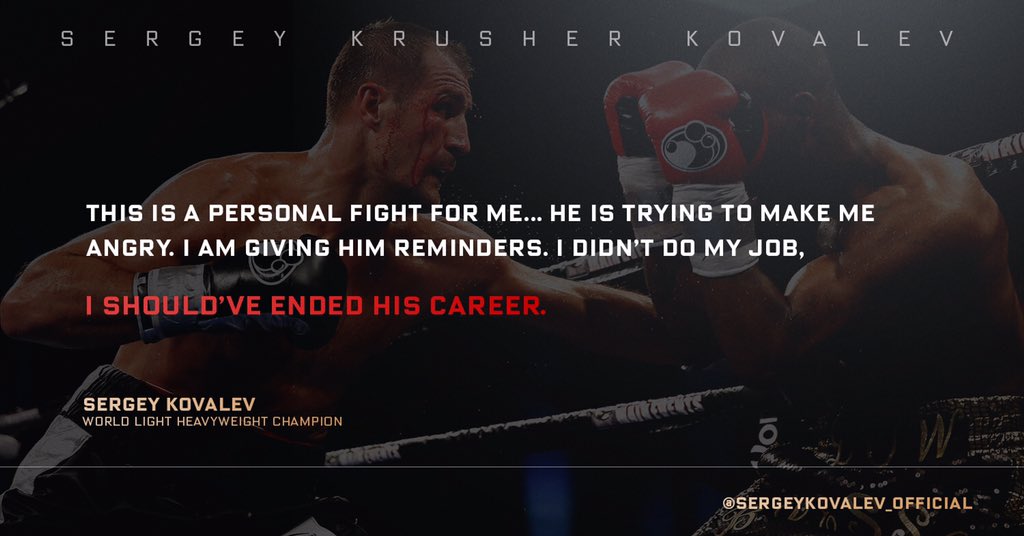
On January 30 light heavyweights Jean Pascal and Sergey Kovalev will face off once again in Montreal.
Kovalev-Pascal II Will Be a Rerun with Coach Roach an Up-Close Spectator
BY Frank Lotierzo ON January 29, 2016
Photo by Herb Whyne
If you saw the first meeting between WBA/IBF/WBO light heavyweight
title holder Sergey Kovalev 28-0-1 (25) and former WBC title holder Jean
Pascal 30-3-1 (17), Kovalev clearly controlled five of the seven rounds before
stopping Pascal in the eighth.
When Kovalev, 31, and Pascal, 33, meet in a rematch Saturday night at
the Bell Centre in Montreal, Pascal will have completed eight weeks of
intense training and preparation under new trainer Freddie Roach.
Once Kovalev hits Pascal good he'll
suddenly remember how things were the first time they fought and
survival will overrule Roach's instructions and fight plan.
Wilt Chamberlain at 7' 1" and 275 pounds verbally agreed to fight Ali on July 26, 1971 in the Houston Astrodome but Wilt extended his contract with the LA Lakers instead.
After their recent drive to the VA hospital, Brenda sat behind Leon
during an occupational therapy session. Six months ago, Leon was
learning how to walk again. Now he stood in front of a video screen
doing exercises that tested his mobility and cognitive skills.
Repeated blows to the head that Leon withstood in 46 professional
fights over more than two decades had led to brain trauma, which was
diagnosed in 2012 by Charles Bernick, a neurologist at the Lou Ruvo
Center for Brain Health in Las Vegas. Leon’s medical ordeal exacerbated
his cognitive impairment.
And after attending a benefit for the Lou Ruvo Center for Brain
Health in 2012, Leon, with Brenda’s support, volunteered to participate
in the clinic’s study of professional fighters’ brains.
Bernick, co-author of the ongoing longitudinal study, examined Leon
and noticed that the brain trauma from Leon’s boxing career affected his
mood, memory and physical changes.
“Here’s a guy who had a lot of fights and who had a successful career and comes out with a lot of
disability from that,” Bernick said. “Yet there’s other people that
fight, maybe not quite as much, but go through their career and don’t
have that (disability). Then the real question of whether it’s in
football or boxing or the military or whatever is what causes that
difference?”
The first stage of the study — with Leon among 93 boxers and 131
martial arts fighters involved in the initial findings — concluded that
repeated blows are linked with smaller volume of certain parts of the
brain and slower processing speeds.
Leon, now among about 500 fighters participating in the longitudinal
study, is scheduled to have more testing soon and will most assuredly
arrive for his appointment with Brenda. No one pays more attention to
Leon’s health than she does, and that’s one reason they spent their
anniversary last year in an emergency room.
Paul
Gallender in his new biography, Sonny Liston -- The Real Story Behind
the Ali-Liston Fights. The author will honor Sonny with a 50th
Anniversary Celebration of his winning the World Heavyweight Boxing
Championship from Floyd Patterson.
"No athlete was ever vilified more viciously and unfairly than Sonny
Liston.
Among other things, Liston was called an inferior Negro, less
than human, slow-thinking, a primitive in a primitive profession, a
latter-day caveman, a savage, glaring eyed gorilla, a rogue elephant, a
congenital thug, a cop hater and stronger than a yoke of oxen and just
as dumb."
So writes Paul Gallender in his new biography, Sonny Liston
-- The Real Story Behind the Ali-Liston Fights.
The author will honor
Sonny with a 50th Anniversary Celebration of his winning the World Heavyweight Boxing Championship from Floyd Patterson at the African American Museum of Philadelphia.
Liston and his wife Geraldine lived in Philadelphia from
1958-1962.
Reznick Presents: Highlights and knockouts of the only undefeated heavyweight champion of the world in boxing history. Rocky Marciano.
Rocky Marciano was an intimidating monster of a fighter.
An
unstoppable force that threw bomb after bomb. Hit him with everything
you got, but he will still chase you down. When you're in the ring with
Rocky, you are fighting for your life.
He knocked out four
legends, giving them the biggest beatings of their career. And retired
undefeated as the heavyweight champion of the world. The only person in
history to ever do so.
Every university president and every sports editor should go back and read Jeanne Marie Laskas' article from 2009, Game Brainthat tells the story of Dr. Bennet Omalu, the
forensic pathologist who first documented the damage
football causes afterexamining the brain of Pittsburgh Steeler, Mike Webster.
Laskas makes you think about and question the collision sport sold as a harmless game. From her 2009 article: "Omalu
did not like the education he was receiving. He felt he was learning
something very ugly about America, about how an $8 billion industry
could attempt to silence even the most well-intentioned scientist and in
the most insidious ways." "In the jar is Omalu’s fifteenth confirmed case of CTE—the most dramatic he’s seen." "The
NFL was already plenty pissed off. They had refused to acknowledge CTE
or any of Omalu’s research or, really, Omalu himself. It seemed they
wanted to simply pretend Omalu did not exist, and he was sick of it,
sick of insisting that yes,
Bennet Omalu is a real person who has discovered a real disease that is
really damaging real people even as you sit there denying it.The public debate with the NFL was a distraction from his research. He would continue his work quietly, examining brains." "Anybody still denying the disease is out of his mind."
Why newsrooms across the country didn't jump on this article back in 2009 and start questioning coaches, parents, and school administrators about what was now scientifically documented probably comes back to the newsroom battle between reporters and cheerleaders.
When
it comes to football, until now the pom pom wavers have usually won. A
movie based on Jeanne Laskas' reporting of Omalu's work may change
that.
Concussion with Will Smith should be mandatory viewing for every every reporter and for every university president. After viewing the university president should do the following: 1. Go to the mirror. 2. Look in the mirror. 3. Ask, "why am I, a university president, not concerned about supporting a sport that causes brain damage?" Every
sports editor should simply ask one question: when will my sports
reporters put down their pom poms and pick up their pens and do some
reporting? Imagine what the football world would look like today if sports reporters were reporters and not cheerleaders. Every
sports cheerleader should write Jeanne Marie Laskas a thank you note
and say "thank you for demonstrating what a reporter is supposed to do."
When journalism fails, bad things happen.